Puglia
Italy's undiscovered heel, authentic and unspoiled
Puglia remains one of Italy's best-kept secrets, though that secret spreads a little further each year. This region forming the heel of the Italian boot offers everything travelers love about the country, including stunning towns, exceptional food, beautiful coastline, and rich history, but with a fraction of the crowds found in Tuscany or the Amalfi Coast. Those who make the journey south discover an authenticity that has become increasingly rare in more famous destinations.
The landscape of Puglia appears almost African in its vastness, a gently rolling plain covered with olive trees as far as the eye can see. These groves, many containing trees over a thousand years old, produce roughly forty percent of Italy's olive oil, and the quality of the extra virgin oil here ranks among the finest in the world. Red soil contrasts with silver-green olive leaves and the white stone walls that divide properties throughout the countryside. The occasional masseria, a fortified farmhouse from centuries past, punctuates the landscape, many now converted to hotels that offer visitors a taste of rural Puglian life.
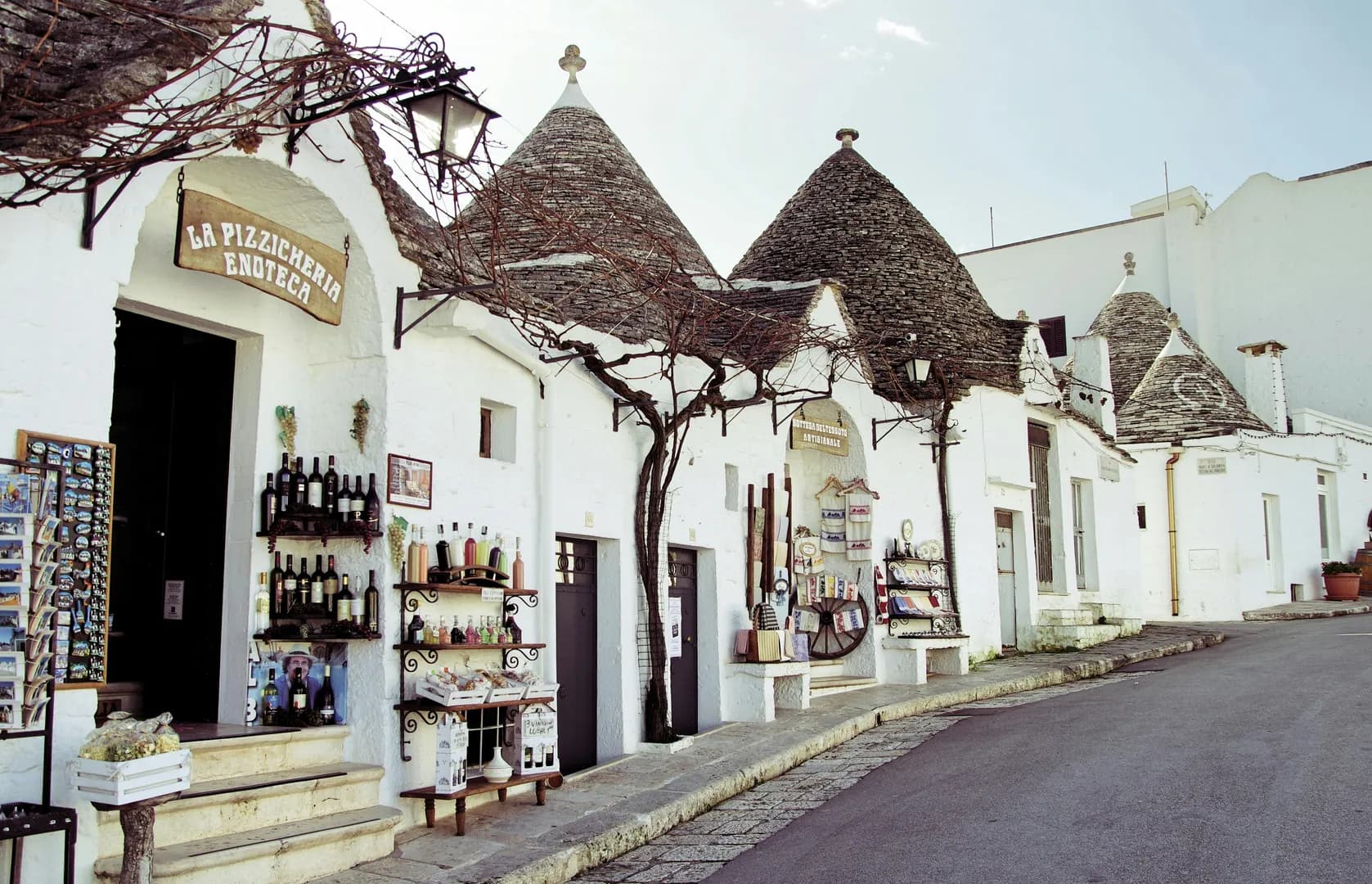
Alberobello presents the most distinctive architecture in Puglia, a town of trulli, the cone-roofed stone buildings that appear nowhere else in such concentration. These structures were built without mortar, allowing them to be quickly dismantled when tax collectors came around, as the story goes. Today the historic center of Alberobello preserves over fifteen hundred trulli, their whitewashed walls and gray stone roofs creating a fairy-tale streetscape unique in Italy. Tourist shops have moved into many trulli, but wandering the quieter back streets reveals the buildings as they have stood for centuries.
Lecce earns its nickname as the Florence of the South through the extraordinary richness of its baroque architecture. The local limestone, pietra leccese, carves easily when fresh from the quarry but hardens with exposure to air, allowing the elaborate decoration that covers the facades of churches and palaces throughout the historic center. The Basilica di Santa Croce presents the most famous example, its facade encrusted with flowers, animals, and figures that seem to writhe across the stone. The pedestrian center comes alive in the evening passeggiata, when residents emerge to stroll, socialize, and enjoy the cooling air after the heat of the day.
Ostuni gleams white on its hilltop, visible from miles away across the surrounding olive groves. This whitewashed city developed its distinctive appearance as a defense against plague, with the lime wash serving as a disinfectant on building surfaces. The effect today is purely aesthetic, a labyrinth of white streets climbing to the cathedral at the summit, punctuated by splashes of bougainvillea and glimpses of the blue Adriatic on the horizon. Ostuni has become popular with northern European visitors in recent years but maintains its character better than many resort towns.
Polignano a Mare offers one of Italy's most dramatic town settings, its buildings perched on cliffs that drop straight to the sea. A small beach tucked into a cove beneath the old town provides swimming access, while restaurants built into caves along the cliff face serve seafood with unmatched views. The town claims to be the birthplace of Domenico Modugno, whose song "Volare" spread Italian music worldwide, and a statue commemorates this contribution to popular culture.
The Salento peninsula, the southernmost portion of Puglia, extends into the sea where the Adriatic meets the Ionian. This area preserves Greek influences from ancient colonies, and some villages still speak Griko, a Greek dialect. The coastline alternates between rocky cliffs and sandy beaches, with crystal-clear water that rivals anything in the Mediterranean. Towns like Gallipoli and Otranto offer historic centers built for defense against maritime attacks, their walls and towers now framing seafood restaurants and beach clubs. The interior holds quiet villages, Byzantine churches with traces of frescoes, and some of Puglia's most authentic rural life.
Just across the border in the neighboring region of Basilicata, Matera presents one of Italy's most extraordinary urban environments. The sassi, cave dwellings carved into the sides of a limestone gorge, housed residents in conditions of shocking poverty until the 1950s, when the government forcibly relocated the population. Today the sassi have been rehabilitated as hotels, restaurants, and residences, their ancient stone chambers providing atmospheric accommodations and a tangible connection to human habitation stretching back thousands of years. The sight of the sassi spreading across the gorge, especially at sunset or when lit at night, justifies the frequent day trips from Puglia.
Food in Puglia achieves a purity that reflects the region's agricultural traditions. The pasta here, particularly orecchiette (little ears) and cavatelli, is typically handmade from semolina flour and water, without eggs, giving it a firm texture that holds chunky vegetable sauces well. The classic preparation pairs orecchiette with cime di rapa, the slightly bitter broccoli rabe that grows throughout the region. Burrata, the cream-filled fresh mozzarella that has conquered menus worldwide, originates in Puglia, and eating it within hours of production reveals what this cheese can really be. Seafood from both coasts appears on tables throughout the region, from raw preparations of local shrimp to elaborate fish stews.
The wines of Puglia have undergone a transformation in recent decades, moving from bulk production to quality bottlings that attract international attention. Primitivo and Negroamaro provide the principal red grapes, capable of producing wines that range from simple and fruity to complex and age-worthy. White wines often feature Verdeca or Fiano, both well-suited to the seafood that dominates coastal cooking. Visiting wineries throughout the region provides insight into this evolution and the opportunity to taste wines that rarely leave Puglia.
Getting around Puglia typically requires a car, as public transportation does not reach many of the most interesting destinations. The roads are generally good, and driving allows the flexibility to explore at your own pace, stopping at masserie and olive oil producers along the way. Distances can be deceptive on the map, so building in extra time for the relaxed pace of southern Italian life makes for a more enjoyable trip.
Planning a Puglia itinerary means accepting that the region is larger than most visitors expect and moving slowly enough to appreciate its particular pleasures. Many travelers base themselves in one or two locations and take day trips, while others prefer to move among different areas. The Valle d'Itria, with Alberobello and the trulli, makes a natural focus. Lecce serves as an excellent base for exploring the Salento. The coast around Polignano and Monopoli offers beaches and seaside charm. However you structure your visit, Puglia rewards with experiences that feel genuinely Italian in ways that more touristed destinations sometimes struggle to provide.
Experiences We Can Arrange
Quick Facts
Best Time to Visit
May to June and September to October offer ideal conditions. Summer is hot but perfect for beaches. This region enjoys more sunny days than almost anywhere in Italy.
Recommended Duration
Five to seven days allows you to explore properly. The region is larger than it appears, and the relaxed pace invites lingering.