Florence
The cradle of the Renaissance, made for lingering
Florence is where the Renaissance happened, and the city has never let anyone forget it. Within a few compact blocks you will find Michelangelo's David, Botticelli's Birth of Venus, Brunelleschi's impossible dome, and streets where Dante, Leonardo, and the Medici walked. For art and history lovers, there is simply no other city like it. And yet the Florence that stays with most travelers is not only the one inside the museums. It is the city of golden evening light on the Arno, of artisan workshops that have operated for generations, and of trattorias where dinner unfolds slowly over a bottle of Chianti.
The historic center is wonderfully walkable, and that is how Florence is meant to be experienced. From the Duomo, with its marble facade and Brunelleschi's terracotta dome rising above the rooftops, nearly everything lies within a fifteen-minute stroll. The Uffizi Gallery holds the world's greatest collection of Renaissance painting, from Giotto through Botticelli to Leonardo and Raphael. The Accademia houses David, a sculpture that genuinely silences first-time visitors no matter how many photographs they have seen. The Bargello, often overlooked, contains a sculpture collection that would be the centerpiece of any other city.
The key to enjoying these treasures is planning. Florence's major museums operate on timed entry, and the most popular slots disappear weeks in advance, especially from late spring through early fall. Climbing Brunelleschi's dome requires a reserved slot that can vanish even earlier. This is a city that rewards travelers who fix their dates and book their tickets before they book their dinners, and it is exactly the kind of logistics we handle for our guests so that a dream trip never turns into a morning spent in a ticket line.
Cross the Ponte Vecchio, the medieval bridge lined with goldsmiths, and you reach the Oltrarno, Florence's left bank. This is where the city's artisan tradition lives on in earnest. Workshops here still practice marbled paper making, bookbinding, leatherwork, and gilding using techniques that predate the Renaissance masters they once served. The neighborhoods of Santo Spirito and San Frediano offer some of the city's best aperitivo squares and a more local rhythm than the monument-dense center across the river.
Florence's food culture deserves as much attention as its art. This is the home of bistecca alla fiorentina, the magnificent Chianina T-bone grilled rare over coals, and of ribollita, lampredotto, and unsalted Tuscan bread that has puzzled visitors for centuries. The Mercato Centrale and Sant'Ambrogio markets show the city's ingredients at their best, and a morning market tour followed by a cooking class in a Florentine kitchen ranks among the most memorable experiences we arrange. In the evenings, the enotecas and family-run trattorias reward those who wander a few streets away from the main squares.
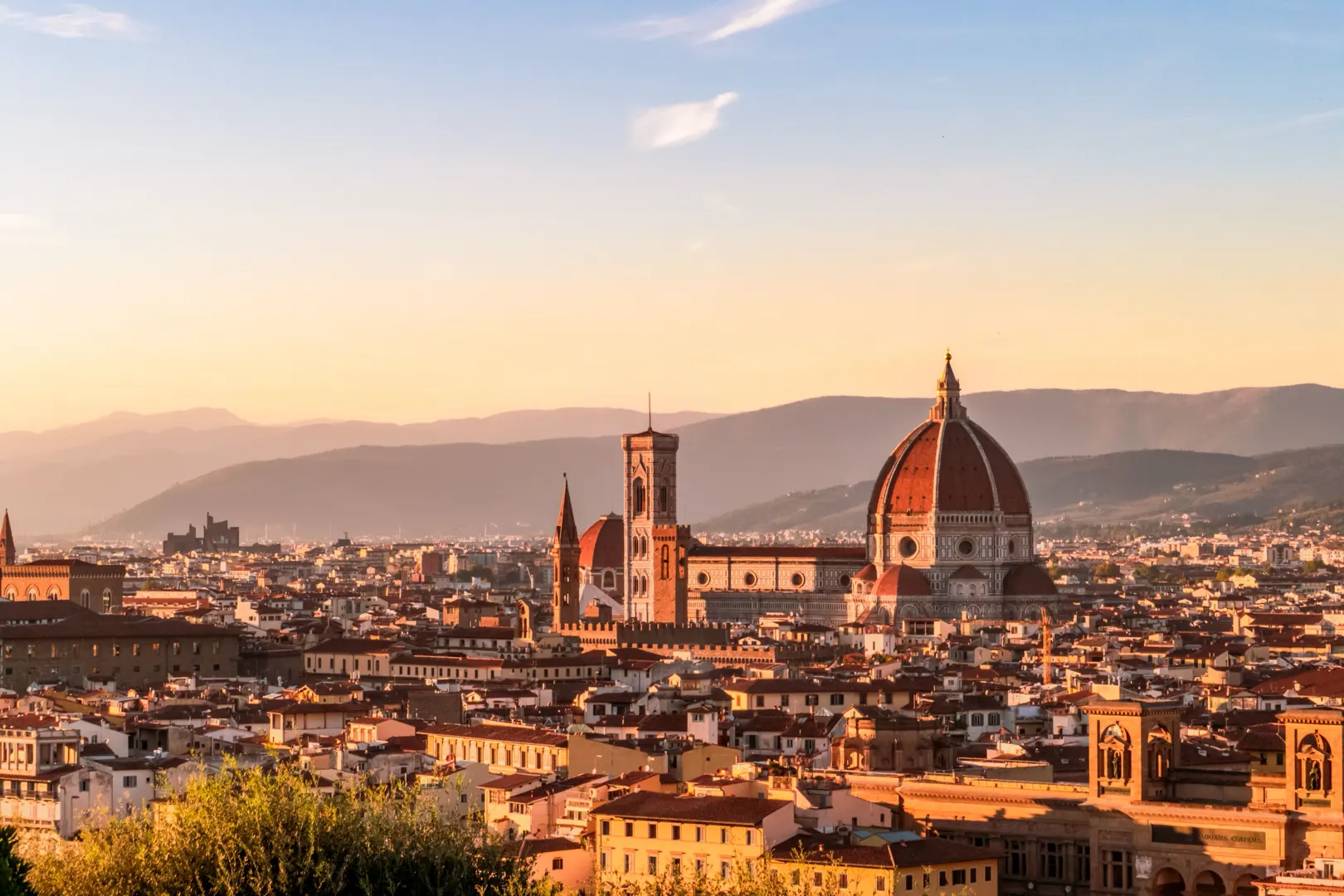
For the best view in the city, climb to Piazzale Michelangelo in the late afternoon and stay as the sun drops behind the skyline. The panorama of the Duomo, Palazzo Vecchio, and the hills beyond is the image most travelers carry home. A few minutes further up the hill, the Romanesque church of San Miniato al Monte offers the same view with a fraction of the crowd, and monks still sing Gregorian vespers most evenings.
Florence also makes an ideal base for exploring the wider region. The vineyards of Chianti begin barely half an hour from the city walls. Siena, San Gimignano, and the Val d'Orcia are all within day-trip range, as are Lucca and Pisa. Fiesole, the Etruscan hill town overlooking the city, can be reached by a short ride and rewards visitors with Roman ruins, quiet lanes, and yet another spectacular view back toward the dome.
The city's compact size cuts both ways. Florence receives enormous numbers of visitors, and in high summer the center can feel crowded and hot by midday. The solution is rhythm: see the great sights early or late, retreat to a long lunch or a shaded garden in the heat of the afternoon, and rediscover the city in the evening when the day-trippers have gone. The Boboli Gardens behind Palazzo Pitti offer green refuge, and the quieter churches, Santa Croce with its tombs of Michelangelo and Galileo, Santa Maria Novella with its frescoed chapels, absorb far fewer people than the headline museums.
Spring and fall are Florence at its finest, with mild weather and light that photographers dream about. Winter has its own rewards: short museum lines, cozy trattorias, and the city returned to the Florentines. However long you stay, Florence rarely feels finished. Most travelers leave with a list of things they did not get to, which is perhaps the surest sign of a city worth returning to.
We typically recommend giving Florence three to four nights, enough for the great museums, the Oltrarno, a proper food experience, and at least one day trip into the surrounding hills. Combined with Tuscany's countryside or connected onward to Rome or Venice by high-speed rail, Florence anchors an itinerary as gracefully as any city in Italy.
Experiences We Can Arrange
Quick Facts
Best Time to Visit
April to June and September to October offer mild weather and the best light. Winter brings short museum lines and a quieter, more local city.
Recommended Duration
We recommend 3 to 4 nights — enough for the major museums, the Oltrarno, and a day trip into the Tuscan hills.