
Where fire meets water off the northern coast of Sicily, seven volcanic islands form an archipelago that has captivated travelers since Odysseus sailed these waters—a place where the earth still breathes, and every sunset eruption reminds visitors they stand on the rim of creation itself.
The Islands of the Wind God
The Aeolian Islands (Isole Eolie) take their name from Aeolus, the Greek god of winds, who according to Homer kept the world's winds imprisoned in a cave on these very islands. When Odysseus landed here during his decade-long journey home from Troy, Aeolus gifted him a bag containing all contrary winds, ensuring swift passage to Ithaca—a gift the hero's curious crew fatally opened, unleashing storms that extended their wanderings by years.1
The myth contains geographical truth: these islands do seem to birth weather. Rising steeply from the sea, their volcanic peaks interact with Mediterranean air masses to create local wind patterns that have challenged sailors since antiquity. The same geological forces generate the thermal activity that makes this archipelago one of Earth's great natural laboratories for understanding volcanic processes.
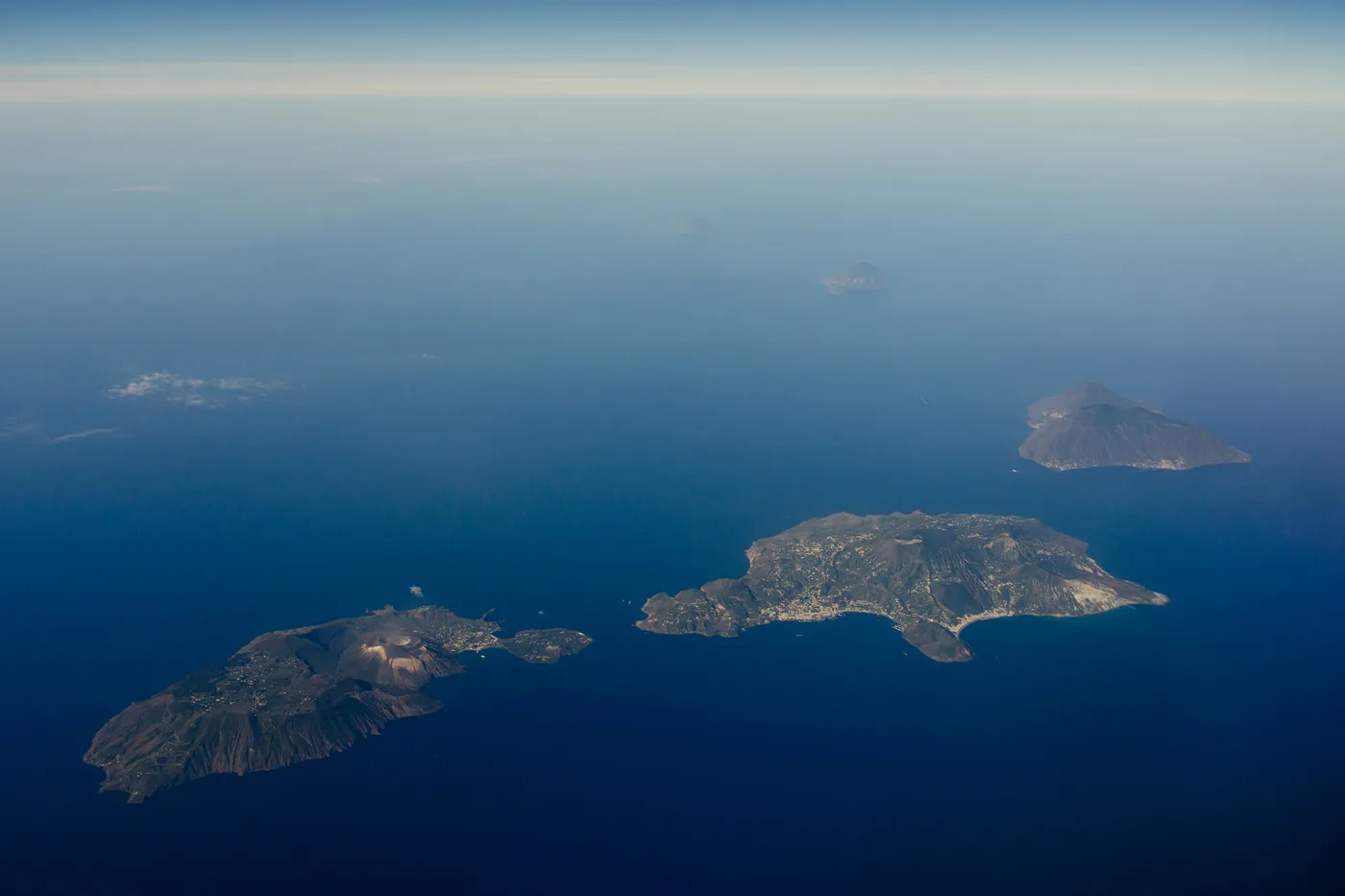
Designated a UNESCO World Heritage Site in 2000, the Aeolians comprise seven inhabited islands—Lipari, Vulcano, Salina, Stromboli, Panarea, Filicudi, and Alicudi—arranged in a rough Y-shape across 70 kilometers of Tyrrhenian Sea.2 Each island possesses distinct character: from Lipari's accessible archaeology to Stromboli's nightly pyrotechnics, from Panarea's glamour to Alicudi's radical simplicity. Together they offer island-hopping of extraordinary variety within manageable geographic compass.
Understanding Aeolian Geology
The Volcanic Arc
The Aeolian Islands represent the emerged portion of a volcanic arc created by the African tectonic plate subducting beneath the Eurasian plate. This ongoing collision—the same process generating Mount Etna and Vesuvius—has produced volcanic activity in this region for approximately one million years, with the current islands representing only the most recent chapter.3
The volcanism continues. Stromboli erupts essentially continuously, having done so for at least 2,000 years of recorded observation and probably far longer. Vulcano's crater still fumes and heats thermal springs along its shores. Even "quiet" islands like Lipari show evidence of eruptions within the past 1,400 years. Scientists monitor the entire archipelago for signs of renewed activity.
This geological dynamism created the dramatic landscapes that draw visitors: black sand beaches and white pumice cliffs, hot springs and fumarolic vents, craters one can hike into and peaks one can watch explode. The Aeolians offer what few places provide—direct experience of the planet's creative and destructive power.
Volcanic Products and Resources
Each eruption leaves distinctive materials. The pumice of Lipari—so light it floats—supplied the ancient Mediterranean world with abrasive material for smoothing wood, cleaning, and personal grooming. Mining continued until 2000, when UNESCO designation ended extraction, leaving quarries now repurposing as beaches and swimming areas.
Obsidian, the volcanic glass prized by prehistoric peoples for tools and weapons, made Lipari a trading center as early as the Neolithic period. Evidence of obsidian from these islands appears at archaeological sites throughout the Mediterranean, testifying to trade networks predating written history by millennia.4
The sulfur deposits of Vulcano attracted industrial extraction from Roman times through the 19th century, when the island's very name—shared with the god of the forge—became the generic term for all such fiery mountains. The legacy continues in steaming fumaroles that visitors can approach (cautiously) and mud baths whose therapeutic value draws crowds despite the overwhelming smell.
The Seven Islands
Lipari: The Archipelago's Heart
The largest and most populous of the Aeolians, Lipari serves as the practical center for exploration. Its main town, also called Lipari, clusters around a fortified rock acropolis whose strategic position attracted settlement from the Neolithic through the present day. The archaeological museum here ranks among Italy's finest for prehistoric Mediterranean material.5
Above the town rises the Castello, a Spanish fortress that incorporates Norman, Greek, and Roman structures in its complex layers. Within its walls, archaeological excavations have revealed continuous habitation spanning 5,000 years—a timeline that allows visitors to literally walk through human history.
Beyond the town, Lipari offers beaches of varied character: the white pumice sands of Spiaggia Bianca, the volcanic black of Canneto, the thermal waters of San Calogero. The interior, accessible by bus or rental scooter, presents landscapes shaped by historical eruptions—obsidian flows from Monte Pelato, pumice quarries transformed into surreal white canyons.
Lipari's accommodation and dining options surpass other islands, making it the natural base for exploration. Ferry and hydrofoil connections serve all sister islands, with most journeys taking under an hour.
Vulcano: The Smoking Gateway
The southernmost major island, Vulcano lies closest to the Sicilian mainland and serves as many visitors' introduction to the archipelago. The island's dominant feature—the Gran Cratere, reaching 391 meters—remains active in the geological sense: fumaroles vent continuously, the ground is hot to the touch, and the possibility of renewed eruption, however statistically remote, lends visits genuine frisson.
The crater hike takes approximately one hour each way and rewards with views across the entire archipelago. The trail passes through surreal landscapes of yellow sulfur deposits and steaming vents; visitors should carry water, wear sturdy shoes, and accept that clothing will absorb sulfurous odors that persist through multiple washings.
At sea level, Vulcano's main attraction is the Laghetto di Fanghi—a natural mud bath fed by volcanic heat and laden with allegedly therapeutic sulfur compounds. Visitors coat themselves in warm grey mud, allow it to dry, then rinse in adjacent hot seawater springs. The experience is memorable, pungent, and surprisingly popular despite conditions that might charitably be called rustic.6
The island's beaches include the famous Spiaggia delle Sabbie Nere (Black Sand Beach), where volcanic sand absorbs Mediterranean sunshine to temperatures requiring footwear. Porto di Ponente offers more sheltered swimming and the best concentration of restaurants and services.
Salina: The Green Island
While her sisters display volcanic terrain in various stages of barren severity, Salina surprises with verdant forests covering twin volcanic peaks—Monte Fossa delle Felci (962m, the archipelago's highest) and Monte dei Porri (860m). Natural springs absent elsewhere in the Aeolians support this unusual lushness, creating an island of striking botanical contrast.7
Salina's three comuni—Santa Marina, Malfa, and Leni—maintain distinct characters. Santa Marina serves as the main port, with the best selection of shops and restaurants. Malfa, on the northern coast, offers access to dramatic cliff scenery and the Scario Galera swimming platform carved into volcanic rock. Leni, quieter still, guards the path to the island's most famous product.
That product is Malvasia delle Lipari, a golden dessert wine produced from semi-dried grapes using techniques established in Greek antiquity.8 It is one of several distinctive wines grown in southern Italy's volcanic soil. Salina's cooler microclimate and water availability make it the production center for this nectar, which visitors can taste at several family-run wineries. The experience—sampling wine beside the vines while looking across water to smoking Stromboli—captures the Aeolian essence.
Film buffs know Salina as the primary location for "Il Postino" (1994), the melancholy masterpiece about Pablo Neruda's fictional Italian exile. The village of Pollara, where key scenes were shot, preserves the atmosphere—and the famous beach, accessed by steep stairs, remains a pilgrimage site.
Stromboli: The Lighthouse of the Mediterranean
No island in the archipelago—perhaps no island anywhere—offers spectacle comparable to Stromboli. The volcano erupts continuously, explosions occurring every 10-20 minutes on average, sending incandescent material hundreds of meters into the air. At night, these eruptions illuminate the sea for miles, earning Stromboli its ancient nickname: the Lighthouse of the Mediterranean.
The island itself consists essentially of a single volcanic cone rising 924 meters above sea level and continuing approximately 2,000 meters below to the seafloor. Approximately 500 permanent residents live in the villages of San Vincenzo, San Bartolo, and Ficogrande on the northeastern coast, protected from eruptions by the crater's geometry, which directs explosions toward the uninhabited Sciara del Fuoco (Stream of Fire) on the northwest flank.9
The summit hike was long Stromboli's defining experience: an afternoon ascent timed to reach the crater rim at dusk, followed by hours watching eruptions from improbably close proximity before descending by headlamp through volcanic ash. Recent safety concerns have restricted summit access to guided groups with permits, and access regulations change frequently in response to volcanic activity—checking current conditions before planning is essential.
Even without summiting, Stromboli rewards. Evening boat tours approach the Sciara del Fuoco from offshore, offering views of eruptions reflected in black water. The Osservatorio viewpoint, accessible on foot, provides eruption views at approximately 400 meters elevation. Simply watching from town as the mountain glows against night sky constitutes sufficient spectacle.
Panarea: The Glamorous Outlier
The smallest inhabited island attracts a disproportionate share of attention—and expense—due to its reputation as celebrity playground. What began as artists' colony in the 1960s evolved into the archipelago's most fashionable destination, where mega-yachts anchor offshore and Milanese fashion types summer in stark white villas.
The reality proves more nuanced than the reputation suggests. Yes, Panarea hosts expensive boutiques and restaurants where bills can shock. But the island also preserves genuine charm in its vehicle-free lanes (only electric carts permitted), its prehistoric settlement at Capo Milazzese (one of the Mediterranean's most important Bronze Age sites), and its waters among the clearest in Italy.10
Day visitors can enjoy Panarea without engaging its glamour economy. The walk from the port to Cala Junco beach passes through village streets of simple beauty, leads to swimming in spectacular surroundings, and returns via Capo Milazzese's archaeological area—all free except ferry fare. Those seeking to overnight should book well in advance during high season and budget accordingly.
Filicudi and Alicudi: The Remote Outposts
The westernmost Aeolians attract visitors seeking genuine escape. These islands offer no cars, limited services, and populations measured in dozens rather than hundreds. What they provide is wilderness, silence, and Mediterranean landscape essentially unchanged from antiquity.
Filicudi (population approximately 200) preserves a few accommodations and restaurants, making it accessible for travelers willing to embrace simplicity. The prehistoric village of Capo Graziano, perched on a headland with views across empty sea, rewards those willing to hike. Underwater, the Secca del Toro coral reef offers some of the archipelago's finest snorkeling and diving.
Alicudi (population approximately 100) goes further—no roads, no vehicles, only mule paths connecting terraced settlements clinging to a single volcanic cone. Electricity arrived only in the 1990s; some residents still cook over wood fires. Visitors sleep in converted fishermen's houses, eat what local gardens and waters provide, and experience disconnection impossible in the modern world.11
These islands are not for everyone. They require advance planning (ferry service is limited), tolerance for unpredictability, and acceptance that creature comforts familiar elsewhere simply don't exist here. But for those seeking the authentic Mediterranean that mass tourism has erased almost everywhere, Filicudi and Alicudi remain.
Planning Your Aeolian Adventure
Getting There
The Aeolians are accessible by ferry and hydrofoil from several Sicilian ports and from Naples. The most common approach uses Milazzo, a mainland port approximately 35 kilometers west of Messina. Regular ferries (2-2.5 hours to Lipari) and hydrofoils (55 minutes) operate year-round, with increased summer frequency.
Alternative connections serve Messina, Palermo, and the Calabrian port of Reggio Calabria. Summer-only hydrofoils from Naples offer direct access for travelers combining Aeolian visits with Campanian itineraries, though the 5+ hour crossing tests patience.
No airports serve the islands; the nearest commercial facilities are Catania (Sicily) and Reggio Calabria (mainland). Helicopter transfers to Panarea exist for those with appropriate budgets. Many travelers combine the Aeolians with a broader Sicily trip, using Milazzo or Catania as the connecting point.
Island Hopping Logistics
Regular ferries and hydrofoils connect all seven islands, making multi-island itineraries straightforward if properly planned. Lipari serves as the hub, with most inter-island connections either originating or terminating there.
Hydrofoils (aliscafi) offer speed at premium prices—journeys between adjacent islands take 10-20 minutes. Schedules run frequently in summer, less so off-season.
Ferries (traghetti) cost less and carry vehicles where relevant, but take significantly longer and may induce discomfort in rough conditions.
Private boat charters provide flexibility, comfort, and access to swimming spots and coastal features unavailable by foot. Half-day and full-day charters suit couples and small groups, with prices varying by season and negotiating skill.
Detailed schedules appear at www.libertylines.it (hydrofoils) and www.siremar.it (ferries). Summer travelers should book in advance for busy routes; winter visitors should confirm services operate, as weather frequently disrupts crossings.
When to Visit
Summer (June-August) brings guaranteed good weather, warmest water, and full service operation—also maximum crowds and prices. August sees Italian vacation at peak intensity, with ferries and accommodations stretched to capacity.
Shoulder seasons (May and September-October) arguably offer the best balance: swimmable water, manageable crowds, operating services, and lower prices. Late September evenings watching Stromboli erupt, wrapped in a sweater against autumn air, provide memories distinct from summer intensity. Travelers drawn to volcanic geology sometimes pair the Aeolians with the thermal springs of Ischia in the Bay of Naples for a fuller picture of Italy's volcanic islands.
Winter (November-April) sees many facilities close, ferries run reduced schedules (and cancel in poor weather), and populations retreat to minimum. However, the islands reveal different character—storms lashing volcanic shores, intimate gatherings in few open bars, the privilege of having beaches and trails entirely to oneself.
Where to Stay and Eat
Lipari offers the greatest accommodation range, from simple rooms to four-star hotels, and serves as the practical base for exploring multiple islands. The old town near the Castello provides atmosphere; Marina Lunga offers beach access.
Salina attracts food-focused travelers, with several notable restaurants and the wine culture absent elsewhere. The boutique hotels here tend toward quiet sophistication.
Stromboli demands at least one night if volcano viewing is a priority—late night eruptions seen from the island itself differ qualitatively from daytime visits. Accommodation is simple but sufficient.
Panarea suits those seeking luxury and social scene, with pricing to match.
Vulcano works best as a day trip from Lipari (15 minutes by hydrofoil) given limited evening entertainment and pervasive sulfur odors.
Filicudi and Alicudi require advance booking for their very limited rooms, and commitment to the simplicity they offer.
Dining throughout the Aeolians emphasizes seafood—swordfish, tuna, sardines, the sea's entire harvest prepared with Sicilian generosity. Capers from Salina are prized throughout Italy; their addition to salads, pasta, and fish preparations provides distinctive Aeolian character. Malvasia wine accompanies desserts and drinking occasions; local cannoli rival Sicilian mainland versions.
The Aeolian Experience
Beyond Tourism
While the islands welcome visitors, they remain working places where fishing, agriculture, and permanent community persist. Even Panarea's glamour represents seasonal overlay on year-round simplicity. Travelers who engage this reality—rising early to see boats return with night's catch, accepting limited options when ferries don't run, eating what's available rather than what's familiar—discover Aeolian hospitality that no resort can manufacture.
Living Geology
The Aeolians offer what few places provide: ongoing experience of planetary formation and destruction. To stand on Vulcano's crater rim inhaling sulfurous gases, to watch Stromboli hurl molten rock into darkness, to swim where underwater vents warm Mediterranean waters is to understand—viscerally, not abstractly—that the ground beneath our feet remains dynamic, temporary, always in process.
This awareness, once acquired, doesn't fade. Long after tan lines disappear and photographs blur together, the sensation persists: we live on a thin crust over fire, our civilizations temporary arrangements on surfaces that will eventually return to magma, our control over nature illusory in geological time. The Aeolians teach this not as depressing truth but as liberating perspective—an invitation to enjoy beauty while it lasts, which is all anyone can ever do.
Frequently Asked Questions
How many days should I spend in the Aeolian Islands?
A minimum of three days allows visits to Lipari, Vulcano, and one additional island. A week permits thorough exploration of 4-5 islands plus time for beaches, hiking, and atmospheric absorption. Two weeks allows serious engagement including the remote western islands.
Can I climb Stromboli independently?
Regulations currently restrict summit access (above 400m) to guided groups with permits. The Osservatorio viewpoint at approximately 400m is accessible independently and provides good eruption views. Regulations change based on volcanic activity—check current conditions before planning.
Is Panarea worth visiting if I'm on a budget?
Day trips allow experiencing Panarea's beauty without its expense. Pack picnic supplies, enjoy free swimming at Cala Junco, visit the Bronze Age settlement, and return to less expensive lodging elsewhere. Overnight stays require substantial budget or extreme advance planning for limited affordable options.
What's the best island for families with children?
Lipari offers the most services, varied beaches, and activities suitable for children (archaeological museum, boat excursions, gelato shops). Salina's gentler landscape suits hiking families. Active volcanism on Vulcano and Stromboli may frighten or fascinate children depending on temperament—parents know their children best.
How rough are ferry crossings?
The Tyrrhenian Sea can be challenging, particularly during winter storms and when wind conditions deteriorate. Hydrofoils suffer more from rough seas than larger ferries. Those prone to seasickness should consider motion sickness medication and flexible schedules that allow waiting for calmer conditions.
Is the Aeolian Islands trip suitable for a day excursion from Sicily?
Day trips from Milazzo to Lipari and Vulcano operate efficiently. However, rushed schedules prevent meaningful engagement with the islands' character. If time truly limits options, a day trip beats nothing—but overnight stays allow Aeolian magic that day visits cannot capture.
References
- Homer. "The Odyssey." Book X. Translated by Robert Fagles. Penguin Classics, 1996.
- UNESCO World Heritage Centre. "Isole Eolie (Aeolian Islands)." World Heritage List Documentation, 2000.
- Peccerillo, A. "Plio-Quaternary Volcanism in Italy." Springer-Verlag, 2005.
- Williams-Thorpe, O. "Obsidian in the Mediterranean and Near East: A Provenancing Success Story." Archaeometry, 1995.
- Museo Archeologico Regionale Eoliano. "Guide to the Collections." Lipari, 2020.
- Sicilian Regional Tourism Authority. "Vulcano: Thermal Facilities and Natural Attractions." Palermo, 2023.
- Ferrara, F. "The Vegetation of the Aeolian Islands." Bollettino dell'Accademia Gioenia di Scienze Naturali, 2009.
- Ferraro, L. "Malvasia delle Lipari: History and Production." Slow Wine Guide, 2022.
- INGV Catania. "Stromboli: Volcano Monitoring Reports." Italian National Institute of Geophysics and Volcanology, 2024.
- Bernabò Brea, L. & Cavalier, M. "The Bronze Age Village at Capo Milazzese, Panarea." Archaeological Investigations, 1991.
- Ferraro, G. "Alicudi: L'isola che non c'è." Sellerio Editore, 2018.