
Why this quietly beautiful city belongs on your Italy itinerary, especially if you sail from or to its port.
Introduction: A Small City with an Outsized Past
At first glance, Ravenna feels like a relaxed Italian provincial town. The streets are calm, the pace is unhurried, and there is none of the overwhelming rush you find in Rome or Venice. Yet behind this gentle atmosphere lies one of the most important cities of Late Antiquity and the early Middle Ages.
Between the early fifth and mid eighth centuries, Ravenna served in turn as the capital of the Western Roman Empire, the Ostrogothic Kingdom of Italy, and the Byzantine Exarchate that governed much of the peninsula. For centuries, emperors, kings, and governors ruled the western Mediterranean from here, and bishops of Ravenna ranked just behind the popes in prestige and influence.1
Today, Ravenna's historic center preserves a remarkably complete set of early Christian monuments and shimmering mosaics from those eras. Eight of these monuments form a single UNESCO World Heritage site, the "Early Christian Monuments of Ravenna".2 For travelers interested in history, art, religion, or simply beauty, Ravenna is one of the most rewarding places you can visit in Italy.
For guests of Italy Awaits Travel, Ravenna offers a perfect complement to cruises departing from its port, to Venice pre- and post-stays, or to journeys through Emilia-Romagna and northern Italy. Interest in Ravenna's port has only grown as Venice's cruise ship ban has reshaped itineraries across the region. Understanding its history will help you see the city not just as a convenient embarkation point, but as a destination with a story as deep as Rome's and as luminous as its own mosaics.
Ravenna Becomes Capital: The Western Roman Empire Moves North
In the early fifth century, the Western Roman Empire was under increasing pressure from Germanic invasions and internal instability. Rome, long the symbolic and administrative heart of the empire, was no longer considered secure. In the year 402, the emperor Honorius made a strategic move: he transferred the imperial court from Milan to Ravenna.1
Several factors made Ravenna attractive as a new capital:
- The city was surrounded by marshes and lagoons, which made it difficult for large armies to attack by land.
- It was close to the important military harbor of Classis on the Adriatic Sea, giving the empire rapid access to naval routes and to Constantinople in the east.
- It was still within reach of the Po Valley and northern Italy, where much of the western empire's remaining economic strength was concentrated.
From this point until the final collapse of the Western Roman Empire in 476, Ravenna functioned as the political center of the west. Decisions about defense, diplomacy, and ecclesiastical policy radiated out from its palaces and episcopal buildings. Even when Rome was sacked by the Visigoths in 410, the emperor remained in Ravenna, underscoring the shift in power from the old capital to this new, more defensible one.
When you walk Ravenna's quiet streets today, it can be difficult to imagine that this was once the beating heart of an empire. Yet the mosaics and church complexes you see are direct products of this period. They were designed to project imperial prestige and Christian authority at a time when the old Roman world was undergoing profound change.
From Empire to Kingdom: Ravenna under Odoacer and Theodoric
In 476, the Western Roman Empire formally ended when the young emperor Romulus Augustulus was deposed by the general Odoacer. The imperial court in Ravenna was dissolved, but the city remained a capital. Odoacer ruled Italy as king from Ravenna, continuing to use Roman institutions while acknowledging the authority of the eastern emperor in Constantinople.1
A second major transition came in 493 when the Ostrogothic king Theodoric defeated Odoacer after a long siege and established Ravenna as the capital of his kingdom. Theodoric is one of the great figures in the city's story, not only as a ruler but as a builder.
Under his reign, Ravenna became a center of culture and learning. Theodoric ordered the construction or renovation of many important structures, including:
- The Basilica of Sant'Apollinare Nuovo, originally his palace church, adorned with long processions of saints and martyrs in brilliant mosaic.
- An Arian cathedral and baptistery, reflecting the fact that Theodoric and many of his Gothic followers followed Arian Christianity rather than the Nicene orthodoxy of Rome.
- His own monumental Mausoleum of Theodoric, built of massive stone blocks and crowned by a single, enormous circular dome.
Theodoric tried to balance Roman traditions with Gothic power, maintaining the Roman senate and administration while placing Goths in key military roles. The architecture of his period mirrors this blend. Buildings often follow Roman forms but include new decorative programs and political messages, showing how a new elite sought legitimacy by adopting the visual language of the empire.
Ravenna and Byzantium: The Exarchate and the Eastern Empire
In the sixth century, the Eastern Roman (Byzantine) Empire under Justinian I attempted to reconquer the western provinces. Ravenna became a focal point of this effort. In 540, the general Belisarius captured the city, and it soon became the seat of the Exarchate of Ravenna, the main Byzantine administrative center in Italy.1,3
For roughly two centuries, Ravenna served as a bridge between Constantinople and the Italian peninsula. The exarch represented imperial authority, overseeing both civil and military matters. Bishops and archbishops of Ravenna grew in influence, and the city's churches were enriched with programs that reflected Byzantine theology and court ceremonial.
Two monuments from this period are especially important:
- Basilica of San Vitale, famous for its octagonal plan and mosaics of Emperor Justinian and Empress Theodora flanking the altar space. These images bring the imperial court into the liturgy and visually assert the connection between Ravenna and Constantinople.
- Basilica of Sant'Apollinare in Classe, located a short distance outside the modern city, where the apse mosaic shows Saint Apollinaris, the first bishop of Ravenna, standing among a stylized green landscape and symbolic sheep. The effect is peaceful yet grand, embodying both local devotion and universal Christian themes.
Between roughly 400 and 750, Ravenna was continuously inhabited by imperial courts, Gothic kings, and Byzantine governors. Over these centuries it grew into one of the most important cities of Late Antique Europe, with a constant flow of ideas, artisans, and clergy between Italy and the eastern Mediterranean.1,3
Decline, Margins, and Preservation
After the Lombards expanded across northern Italy in the late sixth and seventh centuries, Ravenna's political importance began to fade. The Exarchate survived for a time, but in 751 the last exarch was killed and Ravenna eventually came under the control of the papacy and, later, the emerging Italian states.1
Unlike cities that remained central to political and economic power, Ravenna gradually shifted toward the margins. Trade routes changed, ports silted up, and the surrounding wetlands limited large-scale urban expansion. Over the long term, this relative quiet had an unexpected benefit for modern visitors: many of the city's Late Antique and early medieval monuments were never replaced by grand new Baroque or modern structures, and so they survived with relatively limited alteration.
While there were certainly periods of neglect and deterioration, particularly in some neighborhoods, the overall historic core retained its character. Twentieth-century conservation efforts, archaeological campaigns, and the recognition of the city's global importance led to substantial restoration and protection measures. Today, Ravenna offers one of the clearest windows onto the world that emerged as the Roman Empire transformed into medieval Europe.
The Eight UNESCO Early Christian Monuments of Ravenna
Ravenna's most famous treasures are gathered under a single UNESCO World Heritage listing: the Early Christian Monuments of Ravenna. This serial site includes eight different structures built mainly in the fifth and sixth centuries. Together they preserve one of the richest collections of early Christian and Byzantine art anywhere in the world.2
The eight monuments are:
Mausoleum of Galla Placidia – A small cruciform building near San Vitale, its interior is covered in deep blue and gold mosaics. The famous starry sky in the dome and the figure of the Good Shepherd are among the most iconic images in Ravenna.
Neonian (Orthodox) Baptistery – The city's original baptistery for orthodox Christians, with a central dome mosaic showing the baptism of Christ surrounded by the apostles in a circular procession.
Basilica of Sant'Apollinare Nuovo – Once Theodoric's palace church, its long nave walls are lined with processions of saints, martyrs, and female figures moving toward the Virgin and Christ. The rhythm of these mosaics creates a sense of motion that pulls your eye toward the sanctuary.
Arian Baptistery – Built for the Arian Christian community under Theodoric, it also depicts the baptism of Christ but with subtle theological differences that reflect Arian beliefs.
Archiepiscopal Chapel (Chapel of Saint Andrew) – A private oratory for the bishops of Ravenna, decorated with refined mosaics that emphasize orthodox doctrine and the authority of the local church hierarchy.
Mausoleum of Theodoric – Strikingly different from the mosaic-filled interiors elsewhere, this free-standing tomb is built from large stone blocks, capped by a single monolithic dome. Its stark form and engineering make it one of the most unusual monuments in Ravenna.
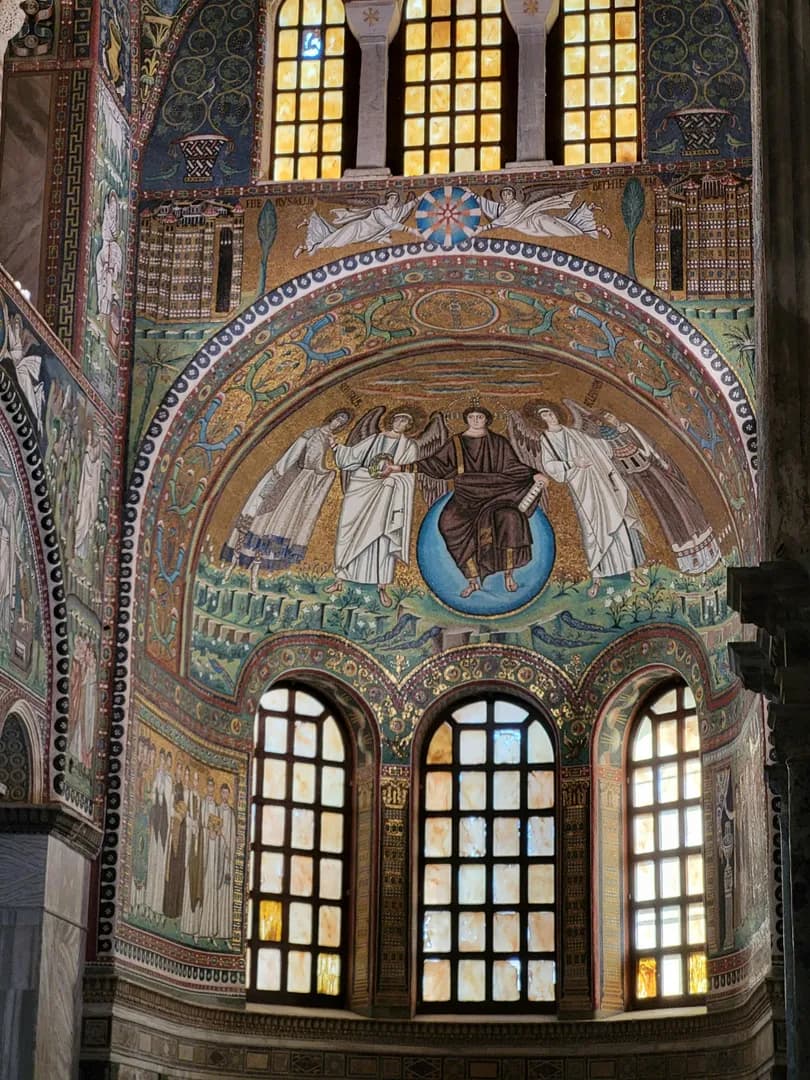
Basilica of San Vitale – One of the masterpieces of early Byzantine architecture. Its octagonal plan and layered gallery spaces lead the eye up to soaring vaults, while the sanctuary mosaics depict Old Testament scenes and the imperial couple Justinian and Theodora in rich ceremonial dress.
Basilica of Sant'Apollinare in Classe – Standing near the site of the ancient harbor of Classe, this basilica's apse mosaic shows Saint Apollinaris in a serene, almost pastoral scene, framed by symbols of Christ and the Transfiguration.
Each site has its own personality and iconography, but together they form a continuous visual narrative. They show how early Christians imagined heaven, authority, and holiness in the generations when the Roman world was changing into the medieval one. The mosaics are remarkably vivid, with blues, greens, and golds that still glow after fifteen centuries.2,4
For many visitors, the experience of walking from one monument to another on foot is one of the great pleasures of Ravenna. Distances in the historic center are short, and yet each doorway leads into a completely different world of color and symbolism.
Ravenna as a Bridge Between Worlds
Historically, Ravenna sits at a crossroads. It is a bridge between:
- The classical Roman world and the emerging medieval order.
- Latin west and Greek-speaking east.
- Imperial government and the rising power of the Christian church.
You can see these transitions written into the art. In some mosaics, Christ is still depicted as a young, beardless figure in classical dress. In others, he appears as a more solemn ruler, with a beard and royal robes, seated on a jewel-encrusted throne. Prophets and apostles wear tunics that echo Roman aristocratic clothing, while angels begin to look more like court officials in shimmering garments.3,4
Ravenna is also a bridge in the literal sense. Its mosaics and architecture translate abstract theological debates into imagery that ordinary worshippers could see and understand. Scenes of sacrifice, martyrs, and processions communicate ideas about authority, orthodoxy, and salvation without a single written word. For modern visitors, especially those without a background in art history, these spaces offer a direct emotional connection to people who lived fifteen hundred years ago.
Ravenna Today: Quiet Streets, Living Crafts
Modern Ravenna is a medium-sized city with a relaxed atmosphere. It is large enough to have cafés, restaurants, and shops that feel local rather than purely touristic, yet compact enough that most visitors can explore on foot. Compared with Rome, Florence, or Venice, the number of tourists is modest. It is often possible to step out of a UNESCO-listed monument and find yourself almost alone on a side street a moment later.4,5
One of the most interesting aspects of a visit is the continuation of the mosaic tradition. Ravenna has developed a reputation as a "city of mosaics", with schools, workshops, and contemporary artists who reinterpret ancient techniques for modern projects. Visitors can tour ateliers, watch artisans at work, or even book short courses to try their hand at placing tesserae themselves.
For food lovers, Ravenna also benefits from its location in Emilia-Romagna. You can pair mornings in UNESCO churches with lunches of fresh seafood, handmade pasta, and local wines. Side trips to nearby cities such as Bologna, Ferrara, or even the seaside resorts along the Adriatic coast are easy to arrange.
How Ravenna Fits into Your Italy Awaits Travel Itinerary
If you are sailing from or to the Port of Ravenna, it is worth reframing the city in your mind. Ravenna is not simply a logistics point between the airport and your ship. It is a destination that can easily support one, two, or even three nights of meaningful exploration.
Here are a few ways Italy Awaits Travel can weave Ravenna's history into your broader journey:
- Pre- or post-cruise stay: Arrive a day or two before your cruise to walk the historic center, visit several UNESCO sites, and relax into Italian time before you board.
- Ravenna plus Venice: Combine Ravenna's quiet mosaics with a few nights in Venice, traveling between them by private car or train while we handle all the details.
- Emilia-Romagna circuit: Build an itinerary that includes Bologna, Parma, Modena, and Ravenna, balancing art, history, and food in one region-based journey.
- Special-interest tours: Focus on early Christian art, architecture, and theology with private guides who can decode the symbolism in the mosaics and connect it to the city's imperial past.
Ravenna rewards slow travel. It is a place where you can stand under a deep blue ceiling filled with golden stars and feel time stretching back fifteen centuries. When that moment is paired with a well designed itinerary, comfortable logistics, and thoughtful guiding, it becomes one of the highlights of a trip to Italy.
If you are curious about how Ravenna might fit into your cruise plans or a wider Italian adventure, contact Italy Awaits Travel. We will help you turn this former capital of empires into a personal highlight of your own journey.
Frequently Asked Questions
Why was Ravenna the capital of the Western Roman Empire?
In 402 CE, Emperor Honorius moved the capital from Milan to Ravenna because the city was surrounded by marshes that made it difficult to attack, it had access to the important harbor of Classis on the Adriatic, and it maintained connections to the eastern empire in Constantinople.
What are the UNESCO sites in Ravenna?
Ravenna has eight UNESCO-listed Early Christian Monuments including the Mausoleum of Galla Placidia, Basilica of San Vitale, Basilica of Sant'Apollinare Nuovo, Basilica of Sant'Apollinare in Classe, the Neonian Baptistery, Arian Baptistery, Archiepiscopal Chapel, and Mausoleum of Theodoric.
How long should I spend in Ravenna?
One to three nights allows you to explore the UNESCO monuments at a comfortable pace. The historic center is compact and walkable, and most major sites can be visited over two full days while leaving time to enjoy local restaurants and cafes.
Can I visit Ravenna before or after a cruise?
Yes, Ravenna is an excellent pre or post cruise destination. The Port of Ravenna serves cruise ships, and spending a night or two in the city allows you to explore its remarkable mosaics and history rather than simply passing through.
What makes Ravenna's mosaics special?
Ravenna's mosaics date from the fifth and sixth centuries and represent some of the finest examples of early Christian and Byzantine art anywhere in the world. They feature brilliant colors, gold backgrounds, and imagery that bridges the classical Roman world and the medieval period.
References
- General historical overview of Ravenna as capital of the Western Roman Empire, Ostrogothic Kingdom, and Byzantine Exarchate, including dates and political transitions from 402–751 CE.
- UNESCO World Heritage Centre, "Early Christian Monuments of Ravenna," describing the eight component sites and their significance as examples of fifth and sixth century religious art and architecture.
- Academic and museum resources on Ravenna's role in Late Antiquity and the early Middle Ages, including its significance as a link between Rome and Constantinople.
- Travel and cultural guides describing Ravenna's mosaics, preservation history, and modern identity as a center for mosaic art and quiet cultural tourism.
- Local tourism materials from Ravenna and Emilia-Romagna providing visiting information, opening hours, and practical tips for exploring the UNESCO monuments.