
Why the bishop of Rome's official seat is not St. Peter's – and how to experience both basilicas on your visit to Italy.
Introduction: Two Basilicas, Two Roles
For many travelers, St. Peter's Basilica is the one church in Rome they already know by name. Its vast dome dominates the skyline of Vatican City, and photographs of its colonnaded square are some of the most recognizable images of Christianity. It is easy to assume that this is the cathedral of Rome and the Pope's official church.
In reality, that honor belongs to a different church altogether: the Archbasilica of St. John Lateran, located on the Caelian Hill inside the city of Rome. St. John Lateran is the cathedral of the Diocese of Rome, the official ecclesiastical seat of the bishop of Rome – who is the Pope – and holds the ancient title "mother and head of all the churches in the city and the world."1,2,3
Both St. John Lateran and St. Peter's trace their origins to the Emperor Constantine in the fourth century. Both are counted among the four major papal basilicas of Rome. Yet they developed very different roles: one as the Pope's cathedral and symbol of his pastoral authority in Rome, the other as a monumental shrine built over the tomb of the Apostle Peter and the practical center of modern papal liturgy.1,4,5
For guests of Italy Awaits Travel, understanding this distinction adds depth to a visit to Rome. Instead of seeing "just another beautiful church," you begin to see how architecture, history, and theology intersect in the spaces you walk through. This article explores the history, status, and experience of both basilicas – and offers suggestions on how to include them meaningfully in your itinerary.
Constantine and the Origins of Rome's Great Basilicas
In the early fourth century, Emperor Constantine's conversion to Christianity dramatically changed the relationship between the Roman state and the Christian community. Until then, Christians had worshipped mostly in private houses or modest halls. Constantine began funding large public churches, or basilicas, within and around Rome.2,6
Two of the most important early Constantinian churches were:
- The Basilica of the Savior on the Lateran hill, later known as the Basilica of St. John Lateran. This was the first official cathedral of Rome, built on land that had belonged to the Laterani family and then passed into imperial hands.2,6
- The original St. Peter's Basilica on Vatican Hill, constructed over a cemetery where early Christians believed the Apostle Peter had been buried after his martyrdom.7,8
Both basilicas followed the typical Roman basilica plan: a long central nave flanked by side aisles and ending in an apse. Both were intended not only as places of worship but as visible signs that Christianity now had the backing of imperial power.
Over the centuries, these two churches evolved in different directions. The Lateran basilica remained the bishop's seat and the setting for important councils and liturgical events, while St. Peter's grew into the principal pilgrimage shrine of the West, associated directly with the memory and relics of the Apostle Peter.
St. John Lateran: Cathedral of the Bishop of Rome
The "Mother and Head" of All Churches
The full official name of St. John Lateran is the "Archbasilica of the Most Holy Savior and of Saints John the Baptist and John the Evangelist at the Lateran." It is the oldest public church in Rome and the oldest basilica in the Western world, originally dedicated in 324 CE.1,2
Above its main entrance is a Latin inscription that translates as: "Most Holy Lateran Church, of all the churches in the city and the world, the mother and head."1,4 This phrase expresses the basilica's status as the principal church of the Catholic world in terms of rank: every other Catholic church, even St. Peter's, is technically junior to it.
The Lateran complex includes:
- The basilica itself.
- The historic Lateran Palace, for centuries a papal residence and the site of several important church councils.
- The octagonal Lateran Baptistery, one of the earliest monumental Christian baptisteries.
Until the papacy moved to Avignon in the fourteenth century, the Lateran was the main residence of the popes. Even after the papal court eventually settled near St. Peter's, the Lateran basilica remained the official cathedral church of Rome and the symbolic seat of the Pope's role as diocesan bishop.1,3
Architecture and Interior
Like many ancient churches, St. John Lateran has been rebuilt and renovated multiple times. Fires in the fourteenth century caused serious damage, and major reconstruction took place in the sixteenth and seventeenth centuries. Architect Francesco Borromini gave the interior a new Baroque order under Pope Innocent X, creating large niches along the nave that now house monumental statues of the apostles.1
The present façade – a dramatic, multi-story composition crowned with statues of Christ, St. John the Baptist, St. John the Evangelist, and various doctors of the Church – dates from the eighteenth century and was designed by Alessandro Galilei. It was completed in 1735 under Pope Clement XII.1
Inside, visitors encounter:
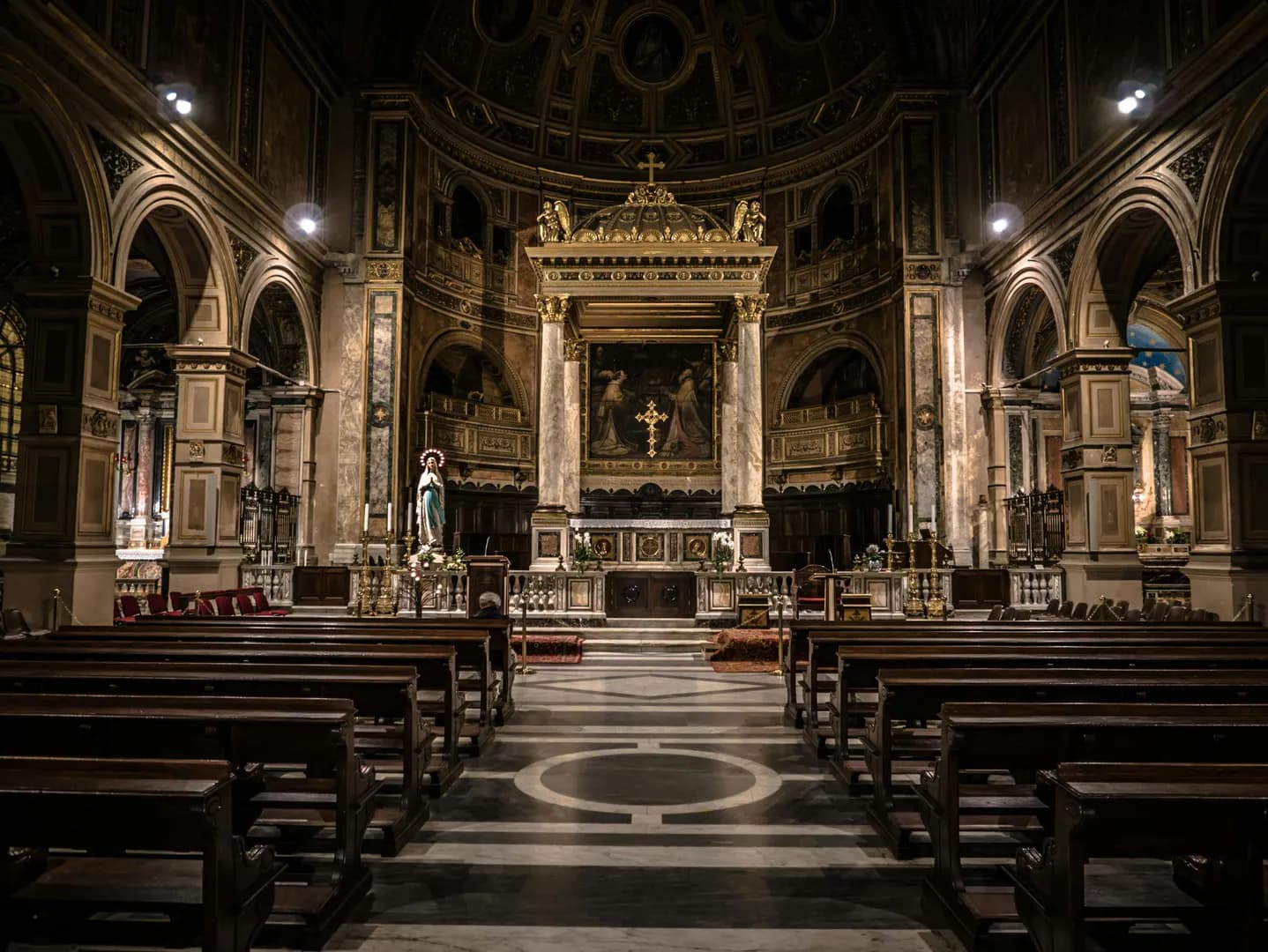
- A wide nave framed by colossal columns and statues, emphasizing the basilica's importance as a cathedral.
- A richly decorated apse with mosaics that echo early Christian imagery while incorporating medieval and Baroque layers.
- The papal cathedra – the bishop's throne – placed prominently in the apse to signify the Pope's role as bishop of Rome.
Across the street stands the Scala Sancta, or "Holy Stairs," a pilgrimage site consisting of a staircase that tradition associates with the steps of Pontius Pilate's praetorium in Jerusalem. Pilgrims sometimes ascend them on their knees in an act of devotion.
St. John Lateran and UNESCO
St. John Lateran is part of the Historic Centre of Rome, which, together with certain extraterritorial properties of the Holy See, is inscribed as a UNESCO World Heritage Site. This recognition reflects not only the basilica's religious significance but also its importance as a monument of art and architecture spanning many centuries.6,9
St. Peter's Basilica: Papal Basilica and Pilgrimage Shrine
Built Over the Tomb of the Apostle Peter
If St. John Lateran is the Pope's cathedral, St. Peter's Basilica is his primary shrine and the global symbol of the papacy. Catholic tradition holds that St. Peter, chief among the apostles, was martyred in Rome under Emperor Nero and buried in a cemetery on Vatican Hill.7,8
Around the year 320, Constantine ordered a large basilica to be built on this site, orienting the apse over the presumed tomb. This original Old St. Peter's Basilica served as a major church and burial site for more than a thousand years, but by the fifteenth century it had deteriorated badly.7
In 1506, Pope Julius II initiated the construction of a completely new church on the same site. Over the next 120 years, some of the greatest architects of the Renaissance and Baroque – including Bramante, Raphael, Michelangelo, and Bernini – contributed designs or elements to the project. The new basilica was consecrated in 1626.5,8
Scale and Design
St. Peter's is one of the largest churches in the world by interior area and volume. Its main nave stretches hundreds of meters, and the soaring dome, designed in its final form by Michelangelo and completed by his successors, rises to approximately 136 meters above the floor.5
Visitors entering from St. Peter's Square pass through a monumental façade and into an immense interior filled with:
- The Baldachin of Bernini, a bronze canopy over the high altar marking the location of Peter's tomb below.
- Numerous side chapels and monuments, including Michelangelo's Pietà.
- The Confessio, an area of steps and railings near the high altar that allows pilgrims to look toward the space of Peter's burial.
From the exterior, the colonnades of St. Peter's Square – also by Bernini – embrace visitors in a giant oval, symbolizing the arms of the Church extended to the world. The entire complex is central to Vatican City, which is itself recognized as a UNESCO World Heritage Site.6
Status: Papal Basilica, Not Cathedral
Though St. Peter's is often called "the most important church in Christendom," its canonical status is different from that of St. John Lateran. St. Peter's is a papal major basilica, one of the four highest-ranking churches in the Catholic world, but it is not the cathedral of Rome.4,5
Officially:
- St. John Lateran is the archbasilica and cathedral of the Diocese of Rome.
- St. Peter's is a papal basilica and major pilgrimage site, located within Vatican City.
In practice, however, most major papal liturgies – especially large Masses, canonizations, and major feast-day celebrations – take place in St. Peter's, simply because it is much larger and directly attached to the modern papal residence and administration.5
The Four Major Papal Basilicas and Their Rank
Within the Catholic Church, the term "major basilica" is reserved for only four churches, all in the Diocese of Rome:
- St. John Lateran (the archbasilica and cathedral).
- St. Peter's in the Vatican.
- St. Mary Major.
- St. Paul Outside the Walls.4,10
These four share several distinctive privileges:
- Each has a Holy Door, traditionally opened during Jubilee Years for pilgrims.
- Each is linked to indulgences and specific pilgrimage routes within Rome.
- They are granted higher ceremonial precedence than all other churches, even other basilicas.
Among them, St. John Lateran alone bears the title archbasilica and "mother and head of all churches," reflecting its function as Rome's cathedral.1,4 St. Peter's, by contrast, is distinguished by its connection to the Apostle Peter and its role as the visual and administrative heart of the Catholic Church today.
Visiting St. John Lateran and St. Peter's: What to Expect
Atmosphere and Experience
Many travelers notice an immediate difference in atmosphere between the two basilicas:
- St. Peter's is often busy and full of movement – guided groups, lines for security, worshippers, and visitors from all over the world. It feels monumental and international.
- St. John Lateran usually feels quieter and more local. Its vast interior is impressive, but the crowds are thinner, and it is easier to pause, sit, and reflect.
For this reason, many guests of Italy Awaits Travel tell us that they are surprised by how much they love the Lateran. St. Peter's gives them the iconic "bucket list" moment, while St. John Lateran gives them space to absorb what they are seeing.
Dress Code and Practicalities
Both basilicas maintain a modest dress code, so it is worth planning what to pack for Italy with these churches in mind. Shoulders and knees should be covered; sleeveless tops and very short shorts are not permitted. Security screening is required at St. Peter's, and lines can be long at peak times, especially around major feast days and on weekends.
At St. Peter's, visitors can:
- Attend Mass or other liturgies (often in various languages).
- Visit the papal grottoes and, with a separate reservation, take an underground tour (the Scavi) toward the area near Peter's tomb.
- Climb the dome for panoramic views over Rome and Vatican City.
At St. John Lateran, highlights include:
- The nave and its monumental statues of the apostles.
- The richly decorated apse and papal cathedra.
- The nearby Lateran Baptistery and, for those interested, the Scala Sancta.
Location and Getting Around
St. Peter's is located in Vatican City, on the west bank of the Tiber. It is reachable by metro (Ottaviano or Cipro stations), bus, taxi, or on foot from central Rome. St. John Lateran stands on the Caelian Hill, southeast of the Colosseum, and is easily accessed via the San Giovanni metro stop or by taxi.
Many visitors plan a full day that includes:
- Morning visit to St. Peter's (and possibly the Vatican Museums, which require separate tickets).
- Lunch near the Tiber or in Trastevere.
- Afternoon visit to St. John Lateran and the surrounding area, sometimes combined with San Clemente or the Colosseum area.
How Italy Awaits Travel Can Enrich Your Visit
Rome's basilicas are more than architectural wonders; they are also layered stories about power, faith, and continuity. Walking through them without context can feel like moving through a beautiful but overwhelming museum. With context, each mosaic, statue, and chapel becomes a piece of a larger narrative.
At Italy Awaits Travel, we can:
- Arrange private or small-group guiding that explains the different roles of St. John Lateran and St. Peter's and points out key details you might otherwise miss.
- Combine basilica visits with broader itineraries that include the early Christian sites of Ravenna, the catacombs along the Appian Way, or other important churches in Rome.
- Coordinate timing around Masses, papal events, or Jubilee celebrations so that your visit aligns with the kind of experience you want – quieter contemplation or participation in major liturgies.
- Integrate your time in Rome with pre- or post-cruise stays, high-speed train travel, and other destinations such as Florence, Tuscany, or the Amalfi Coast.
Whether you come to Rome as part of a cruise from Civitavecchia, a journey through Italy by train, or a once-in-a-lifetime pilgrimage, seeing both St. John Lateran and St. Peter's with understanding is one of the most rewarding experiences you can have in the city.
If you are ready to explore Rome's great basilicas in a way that feels thoughtful rather than rushed, contact Italy Awaits Travel. We would be honored to help you weave these extraordinary churches into an itinerary that reflects your interests, pace, and sense of wonder.
Frequently Asked Questions
Is St. Peter's Basilica the Pope's cathedral?
No. St. John Lateran is the official cathedral of the Diocese of Rome and the Pope's church as Bishop of Rome. St. Peter's is a papal basilica and major pilgrimage shrine built over the tomb of the Apostle Peter, but it is not technically a cathedral.
Why is St. John Lateran called the mother of all churches?
An inscription above the entrance reads "mother and head of all the churches in the city and the world." As the oldest public church in Rome, dedicated in 324 CE, St. John Lateran holds precedence over all other Catholic churches, including St. Peter's.
What are the four major papal basilicas in Rome?
The four major papal basilicas are St. John Lateran (the archbasilica and cathedral), St. Peter's in the Vatican, St. Mary Major, and St. Paul Outside the Walls. Each has special privileges including a Holy Door opened during Jubilee years.
Which basilica is more crowded?
St. Peter's is typically much busier with long security lines, especially on weekends and during major feast days. St. John Lateran is usually quieter with fewer crowds, giving visitors more time to reflect and appreciate the architecture.
Can I visit both basilicas in one day?
Yes, many visitors combine both in a full day. A common approach is to visit St. Peter's and the Vatican area in the morning, have lunch near the Tiber or in Trastevere, then take a taxi or metro to St. John Lateran in the afternoon.
References
- Historical and architectural information on the Archbasilica of St. John Lateran, including its status as the cathedral of Rome and the inscription "mother and head of all churches."
- Constantine and the founding of St. John Lateran as the first public Christian basilica in Rome, dedicated circa 324 CE.
- The role of St. John Lateran as the Pope's cathedral church and the symbolic seat of his authority as Bishop of Rome.
- Catholic Church documentation on the four major papal basilicas and their respective ranks and privileges.
- St. Peter's Basilica history, construction timeline (1506–1626), and its role as the principal papal basilica and pilgrimage site.
- UNESCO World Heritage listing for the Historic Centre of Rome and Vatican City, including both basilicas.
- The tradition of St. Peter's martyrdom and burial on Vatican Hill, and Constantine's construction of Old St. Peter's Basilica over the tomb site.
- Renaissance and Baroque architects (Bramante, Michelangelo, Bernini) and their contributions to the new St. Peter's Basilica.
- UNESCO recognition of St. John Lateran as part of the extraterritorial properties of the Holy See within the Historic Centre of Rome.
- The four major papal basilicas of Rome: St. John Lateran, St. Peter's, St. Mary Major, and St. Paul Outside the Walls.