
If you have already done Rome, Florence, and Venice, Puglia is the answer. Plan on 5-7 days, fly into Bari or Brindisi, rent a car, and split your time between whitewashed hill towns in the Valle d'Itria, Baroque Lecce, and the Adriatic coast. It is the region where Italians themselves go on vacation, and it delivers a version of Italy that feels lived-in rather than curated for tourists.
Why Should Rome, Florence, and Venice Travelers Go to Puglia Next?
Puglia gives repeat visitors to Italy something the classic triangle cannot: space, quiet, and a food and landscape identity that has nothing to do with Renaissance art or gondolas. The heel of Italy's boot is flat and sun-bleached, shaped by olive groves, limestone farmhouses, and a coastline alternating between dramatic cliffs and soft sand.
In my experience, clients who have already checked off the major cities fall hardest for Puglia. There is no single monument to see and move on from; instead, you rent a car and let the small towns, beaches, and long lunches set the pace. I always send first-time Puglia travelers to our Puglia destination guide, which lays out the geography in more visual detail than a single post can.
How Do You Get to Puglia From the United States?
There is no year-round nonstop flight from the US to Puglia, so most American travelers connect through Rome or Milan and take a short domestic flight to Bari (BRI) or Brindisi (BDS). That said, the picture is changing: United Airlines began seasonal nonstop service between Newark and Bari on May 1, 2026, running four times weekly on a Boeing 767-300ER, the first US carrier to link Puglia directly with America.1
Outside that seasonal window, ITA Airways, Lufthansa, and Turkish Airlines are the most common routings, typically connecting through Rome, Frankfurt, Munich, or Istanbul.2 Which airport you choose matters: Bari is the larger hub, closer to the Valle d'Itria and Polignano a Mare, while Brindisi sits only about 40 minutes from Lecce, versus roughly 90 minutes from Bari.3 If your itinerary moves north to south, an open-jaw ticket into Bari and out of Brindisi saves a backtrack across the region.
What Is the Valle d'Itria and Why Is It the Heart of a Puglia Trip?
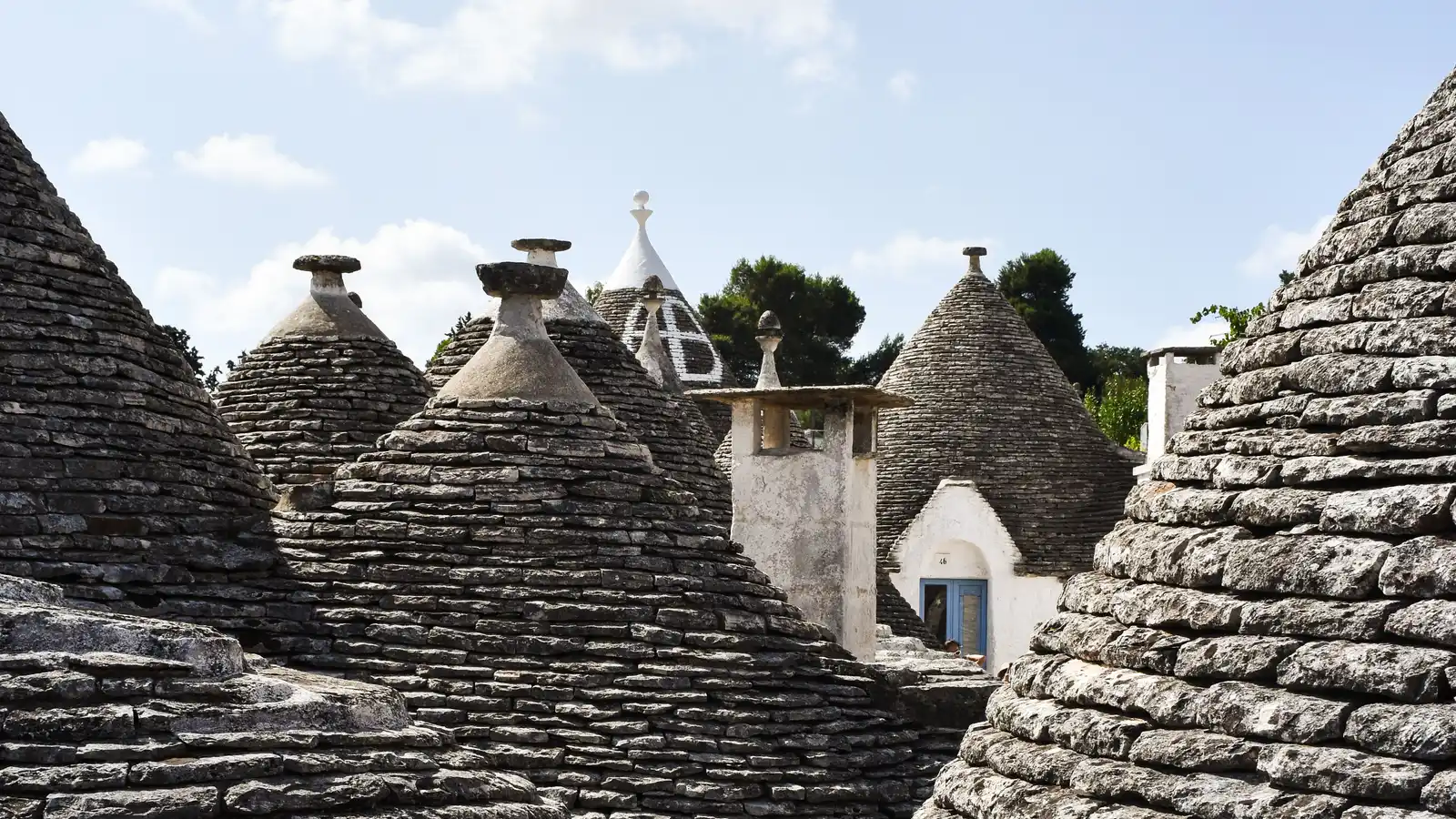
The Valle d'Itria is the rolling, whitewashed countryside in central Puglia where nearly every postcard image of the region comes from: the trulli of Alberobello, the circular hill town of Locorotondo, the white city of Ostuni, and the Baroque market town of Martina Franca, all within a 30-minute drive of each other.
Alberobello is the obvious anchor. Its historic quarter, made up of more than 1,500 conical stone trulli, was inscribed as a UNESCO World Heritage Site in 1996 for its dry-stone corbelled construction, a prehistoric building technique still practiced nowhere else in Europe at this scale.4 Go early morning or evening; midday brings tour buses.
Locorotondo is built in a near-perfect circle around its hilltop center and is the quietest of the group. Ostuni, La Città Bianca, tumbles down a hillside in cascading whitewashed houses with olive groves and the Adriatic visible from its upper streets. Martina Franca, the largest of the four, feels more like a working town, with Baroque palaces set among the same white facades. Base yourself in or near this cluster for at least two nights; it rewards unhurried exploring more than a single day trip can.
Is Lecce Worth the Detour Into Salento?
Yes. Lecce is Puglia's Baroque anchor in the south, nicknamed "the Florence of the South" for its concentration of ornate 17th-century architecture, built almost entirely from soft, golden pietra leccese limestone.5 The historic center holds roughly 20 Baroque churches in a compact, walkable core, with the Basilica di Santa Croce and Duomo square as standout stops.
Lecce sits at the gateway to Salento, Puglia's southernmost peninsula, and makes a natural final base if flying out of Brindisi. Plan a full day in the city and, if time allows, another day or two in Salento's beach towns further south.
What Are Polignano a Mare and Monopoli Like?
Polignano a Mare and Monopoli are the two coastal towns most travelers pair with a Valle d'Itria base, and they are different enough to justify visiting both. Polignano a Mare is built directly onto limestone cliffs above the Adriatic, with Lama Monachile, a pebble cove wedged between two cliff faces and crossed by a Bourbon-era bridge, as its signature sight.6 It is genuinely beautiful, but also crowded in summer; come at sunrise or evening for the version that made it famous in photographs.
Monopoli, a short drive south, has a working fishing harbor, a less-manicured old town, and noticeably fewer tourists, which makes it my preferred base of the two. Both sit close enough to Alberobello, Ostuni, and Locorotondo for a driver to see all five in a long day, though I would not recommend trying to.
Do You Need a Car in Puglia?
Yes, and this is the good news: driving in Puglia is dramatically easier than driving the Amalfi Coast. Most of the region is flat, roads between towns are wide and lightly trafficked, and parking outside historic centers is generally straightforward.7 The one exception is the Gargano Peninsula in the north, with its winding, mountainous roads, but that falls outside the route most first-time visitors follow.
Public transportation between the small hill towns is limited, so a rental car, or a private driver, is close to essential for the itinerary in this guide.
What Is a Masseria, and Should You Stay in One?
A masseria is a fortified agricultural estate unique to Puglia, typically dating from the 15th or 16th century, built around a central courtyard with whitewashed walls, vaulted ceilings, and a working history in olive oil, wine, or grain production.8 Many were built without ground-floor windows and used stone-dropping defenses called machicolations, a legacy of centuries spent defending against coastal raids. Today, dozens have been converted into hotels, and staying in one is, in my opinion, the best way to experience Puglia's countryside rather than just pass through it.
Rates vary widely by property and season. At Masseria Torre Coccaro, a well-known five-star masseria near Fasano, 2026 published rates run from about €357 a night for a standard double in low season up to roughly €2,800 for a two-bedroom villa at peak summer.9 Other well-regarded luxury masserias generally start between €300 and €700 a night, with the most exclusive properties, such as Borgo Egnazia, closer to €1,000. Shoulder-season rates run meaningfully lower.
For a fuller comparison of masserias against hotels, villas, and agriturismi elsewhere in Italy, see this accommodation guide rather than repeating that ground here.
How Many Days Do You Need in Puglia?
Plan on a minimum of 5 to 7 days, and closer to 7 if you want to cover both the Valle d'Itria and Salento without rushing. Five days works if you pick one focus area, either the hill towns and coast or Lecce and Salento, but it leaves little room to simply sit at a beach club or masseria pool, which is much of the point of visiting.
For longer stays, two bases are more comfortable than one: a masseria or hill-town stay for the Valle d'Itria portion, and a base near Lecce or the coast for Salento. Packing and unpacking once, rather than daily, keeps the trip feeling like a vacation rather than a road rally.
When Is the Best Time to Visit Puglia?
May, June, and September are the best months to visit Puglia, combining warm, swimmable weather with meaningfully smaller crowds than peak summer. Beach clubs and lidos generally open mid-to-late May, so late May through June gives you open beaches and manageable numbers, and September offers the same balance as crowds thin out.5
August is the month to avoid, or at least approach with caution. It is when Italians themselves take their summer holidays, and beaches, restaurants, and coastal towns fill accordingly; July is only slightly better. Shifting even two or three weeks out of peak August makes a real difference in crowd levels and rates.
What Is the Beach Scene Like in Puglia?
Puglia's coastline runs from dramatic limestone cliffs to long stretches of soft white sand, and the two standout areas are the central Adriatic coast around Polignano a Mare and Monopoli, and the beaches of Salento further south. The Adriatic coast near Polignano is defined by cliff-diving spots, rock coves like Lama Monachile, and small pebble beaches tucked beneath the towns. Salento, particularly the Ionian coast near Gallipoli and Porto Cesareo, trades cliffs for turquoise water and sandy shoreline more often associated with the Caribbean than the Adriatic.
Beach clubs (stabilimenti) with sunbed and umbrella rental are the norm, alongside free public beaches (spiagge libere) for travelers who prefer to bring their own towel. Arriving early in high season secures the better spots.
What Food Defines a Trip to Puglia?
Puglia's food identity centers on orecchiette pasta, burrata cheese, and some of Italy's finest olive oil, all rooted in the region's long peasant-farming history. Orecchiette, the small ear-shaped pasta hand-shaped from durum wheat dough, is traditionally served with cime di rapa (turnip greens) or a simple tomato sauce. Burrata, the cream-filled cousin of mozzarella, was invented in the town of Andria in the 1920s and now carries Protected Geographical Indication status as Burrata di Andria PGI.10
Puglia is also Italy's largest olive oil producing region, and the groves you pass between hill towns are the local economy, not scenery. If wine is more your focus, I go deep on Puglia's Primitivo and other overlooked wine regions in this post.
A Suggested 6-Day Puglia Route
This route assumes you fly into Bari and out of Brindisi, avoiding backtracking, and splits your nights between a Valle d'Itria base and a Salento base.
| Day | Base | What to Do |
|---|---|---|
| 1 | Valle d'Itria (masseria) | Land in Bari, pick up your car, drive to your masseria, settle in |
| 2 | Valle d'Itria | Alberobello in the early morning, Locorotondo for lunch, Ostuni at sunset |
| 3 | Valle d'Itria | Martina Franca, olive oil or wine tasting, relaxed evening at the masseria |
| 4 | Coast | Polignano a Mare in the morning, Monopoli in the afternoon and evening |
| 5 | Lecce / Salento | Drive to Lecce, full day exploring the Baroque historic center |
| 6 | Salento coast | Beach day near Gallipoli or Porto Cesareo, depart from Brindisi |
Adjust the pacing if you have more than six days; a second night in Lecce or an extra beach day in Salento is the easiest way to extend this route.
Puglia rewards travelers willing to slow down and plan around a car, a masseria, and a short list of towns rather than a packed checklist. If you would like help building a custom Puglia itinerary, take a look at our planning services or get in touch and we will put one together suited to how you actually like to travel.
FAQ
Is Puglia better than the Amalfi Coast?
They are different trips rather than direct competitors. Puglia offers easier driving, lower accommodation costs, and a quieter, more agricultural landscape, while the Amalfi Coast offers dramatic cliffside scenery but narrower roads and heavier summer crowds.
Should I fly into Bari or Brindisi for Puglia?
Fly into Bari if your trip centers on the Valle d'Itria, Alberobello, and the central Adriatic coast, since it is the larger, better-connected airport and sits closer to those towns. Fly into or out of Brindisi if Lecce and Salento are a major part of your itinerary, since it is only about 40 minutes from Lecce compared to roughly 90 minutes from Bari.
Do I need to rent a car for a Puglia trip?
Yes, in almost all cases. Public transportation between Puglia's small hill towns is limited, and the region's appeal depends on moving at your own pace. Driving in Puglia is considerably easier than the Amalfi Coast or Cinque Terre, with flat terrain and wider, less congested roads outside historic centers.
What is the difference between a masseria and an agriturismo?
Both are countryside properties rooted in agriculture, but a masseria is specifically a fortified Puglian farming estate, often centuries old, built around a defensible courtyard. An agriturismo is a broader Italian category for a working farm offering guest accommodations found throughout the country, not just Puglia.
How many days should I spend in Puglia?
Plan on 5 to 7 days at minimum. Five days works if you focus on either the Valle d'Itria and coast or Lecce and Salento, while 7 days lets you comfortably cover both without rushing between bases.
Is Puglia expensive to visit?
Puglia is generally less expensive than Tuscany, Amalfi, or Venice for comparable quality, though top-tier masserias like Borgo Egnazia rival any luxury property in Italy at roughly €1,000 or more a night. Mid-range luxury masserias typically run €300 to €700 a night, with meaningfully lower shoulder-season rates.
References
- TravelWise — United Airlines to Launch Direct Bari-New York Flights in May 2026 (2025). https://www.travelwiseway.com/section-news/news-united-airlines-to-launch-direct-barinew-york-flights-in-may-2026-18-10-2025.html
- Momondo — Cheap Flights from the United States to Bari search data (2026). https://www.momondo.com/flights/united-states/bari
- Cerrato Limo — Bari or Brindisi? Best Airport for Puglia & Lecce (2026). https://cerratolimo.com/en/puglia-airports-comparison-guide
- UNESCO World Heritage Centre — The Trulli of Alberobello. https://whc.unesco.org/en/list/787/
- Puglia Guys — The Best Time to Visit Puglia: A Seasonal Guide (2025). https://www.pugliaguys.com/2025/06/26/best-time-to-visit-puglia/
- Lama Monachile — official site on Polignano a Mare's iconic beach. https://lamamonachile.com/
- The Road Reel — Driving in Puglia, Italy (2026): Safety, Difficulty & Tips. https://www.theroadreel.com/driving-in-puglia-italy/
- The Thinking Traveller — Masseria Puglia: The Ultimate Guide to Italy's Fortified Farmhouse Stays. https://www.thethinkingtraveller.com/blog/masserie-in-puglia
- Masseria Torre Coccaro — official 2026 tariffs and reservations page. https://masseriatorrecoccaro.com/en/tariffs-and-reservations
- Wine and Travel Italy — Burrata di Andria IGP: history and production. https://wineandtravelitaly.com/food/burrata-di-andria-igp/