Clinging to the vertical rock face of Monte Baldo like an architectural miracle, the Sanctuary of Madonna della Corona appears less built than summoned into existence—a white vision against grey stone that has drawn pilgrims for five centuries and now attracts travelers seeking one of Italy's most improbable and moving sacred spaces.
A Church Suspended in Air
Some buildings belong to their landscape; others impose themselves upon it. The Sanctuary of Madonna della Corona does neither. It inhabits a liminal space—literally and spiritually—between heaven and earth, carved into a sheer cliff face where neither logic nor engineering suggest a church could exist. From the valley floor nearly 800 meters below, the white sanctuary appears as a pale wound in the mountainside; from the cliff-edge viewpoints above, it reveals itself as an impossible perch, defying gravity and reason with serene indifference.
The sanctuary sits at 774 meters elevation on Monte Baldo's eastern face, directly above the narrow gorge where the Adige River has carved its passage from the Alps toward Verona and the Adriatic.1 The location—simultaneously dramatic and strategic—has attracted religious devotion since at least the medieval period, when hermits first occupied natural caves in these cliffs, seeking the isolation that proximity to the divine seemed to require.
Today, approximately 500,000 visitors annually make the journey to Madonna della Corona, ranging from devout pilgrims who climb the ancient path on their knees to tourists whose cameras struggle to capture what the eye can barely believe.2 All arrive at the same conclusion: this is a place unlike any other, where the boundary between built and natural, human and divine, blurs into something approaching the sacred.
Origins and Legend
The Miraculous Statue
The founding legend of Madonna della Corona centers on a statue of the Pietà—the Virgin Mary cradling the body of the crucified Christ. According to tradition, this wooden sculpture stood on the island of Rhodes, where the Knights of St. John maintained their Mediterranean stronghold until the Ottoman conquest of 1522. When Muslim forces overwhelmed the Christian defenders, the statue miraculously transported itself across the Mediterranean, appearing in a cave on Monte Baldo's cliff face.3
Historical analysis suggests a more prosaic but equally interesting origin. The statue, now dated to the late 15th century, was likely created in Germany and brought to the existing hermitage site by local devotees—a common pattern in an era when prestigious sacred objects moved through networks of commerce and pilgrimage. The "miraculous transportation" narrative, developing in subsequent centuries, expressed in mythological terms the genuine sense of wonder that this impossible location inspired.4
Whatever its true origins, the statue became a focus of devotion that transformed a hermit's cave into a pilgrimage destination. The small community of religious who maintained the site constructed first a chapel, then increasingly elaborate structures, literally carving living space from the cliff face and anchoring buildings to rock that seemed to offer no purchase.
Architectural Evolution
The current sanctuary, while maintaining medieval foundations and Renaissance elements, largely reflects an ambitious 1899 reconstruction that expanded the church to accommodate growing pilgrim numbers.5 This intervention, designed by architect Giuseppe Trecca, created the dramatic white facade now visible from the valley—a bold assertion of presence against the mountain's massive indifference.
The 20th century brought further modifications: installation of the current Via Crucis (Stations of the Cross) along the approach path in 1947, construction of a tunnel providing vehicle access in 1982, and ongoing structural reinforcement addressing the perpetual challenge of building in such precarious position. A significant restoration completed in 1988 addressed decades of weathering and structural strain.6
Throughout these changes, the sanctuary has maintained its essential character: a place where human devotion confronts natural impossibility, creating sacred space through sheer persistence.
Approaching the Sanctuary
The Pilgrim's Path
The traditional approach to Madonna della Corona begins at the village of Brentino Belluno in the Adige Valley, following a path that pilgrims have walked for centuries. This route, approximately 2.5 kilometers in length, climbs through forest along the ancient "Sentiero della Speranza" (Path of Hope), passing stone chapels marking the traditional Stations of the Cross.
The ascent gains approximately 600 meters in elevation—a substantial climb that takes most walkers 90 minutes to two hours depending on pace and fitness. The path itself, paved with stone for much of its length, presents no technical difficulty but demands reasonable cardiovascular capacity. The gradient varies, with some sections quite steep, though benches at intervals offer rest opportunities.
For those approaching the climb as pilgrimage rather than exercise, the Stations of the Cross punctuate the journey with opportunities for reflection. These bronze sculptures, installed in 1947 by artist Raffaele Bonente, depict Christ's final journey with emotional intensity appropriate to the setting.7 Whether or not visitors embrace the religious content, these stations provide structure to the ascent, marking progress and offering visual focus beyond personal exertion.
The final approach reveals the sanctuary gradually—first glimpses through trees, then the dramatic moment when the path emerges onto the terrace and the full impossible vision presents itself: church clinging to cliff, cliff rising toward peaks, peaks disappearing into sky.
The Modern Access
For visitors unable or unwilling to walk the traditional path, a road and tunnel built in 1982 provides vehicle access to parking areas near the sanctuary. The tunnel, carved through Monte Baldo's rock, emerges at an elevation only slightly below the church, reducing the final approach to a short walk.
This access has transformed visitation patterns, enabling elderly pilgrims, families with young children, and less mobile travelers to reach a destination previously requiring significant physical capability. The result, predictably, is a more crowded sanctuary—but also a more democratic one, where the experience is no longer reserved for the physically fortunate.
A shuttle bus operates from the village of Spiazzi, located on the plateau above the sanctuary, for those who drive to the upper parking areas and prefer not to walk even the moderate distance down to the church.
Inside the Sanctuary
The Church Interior
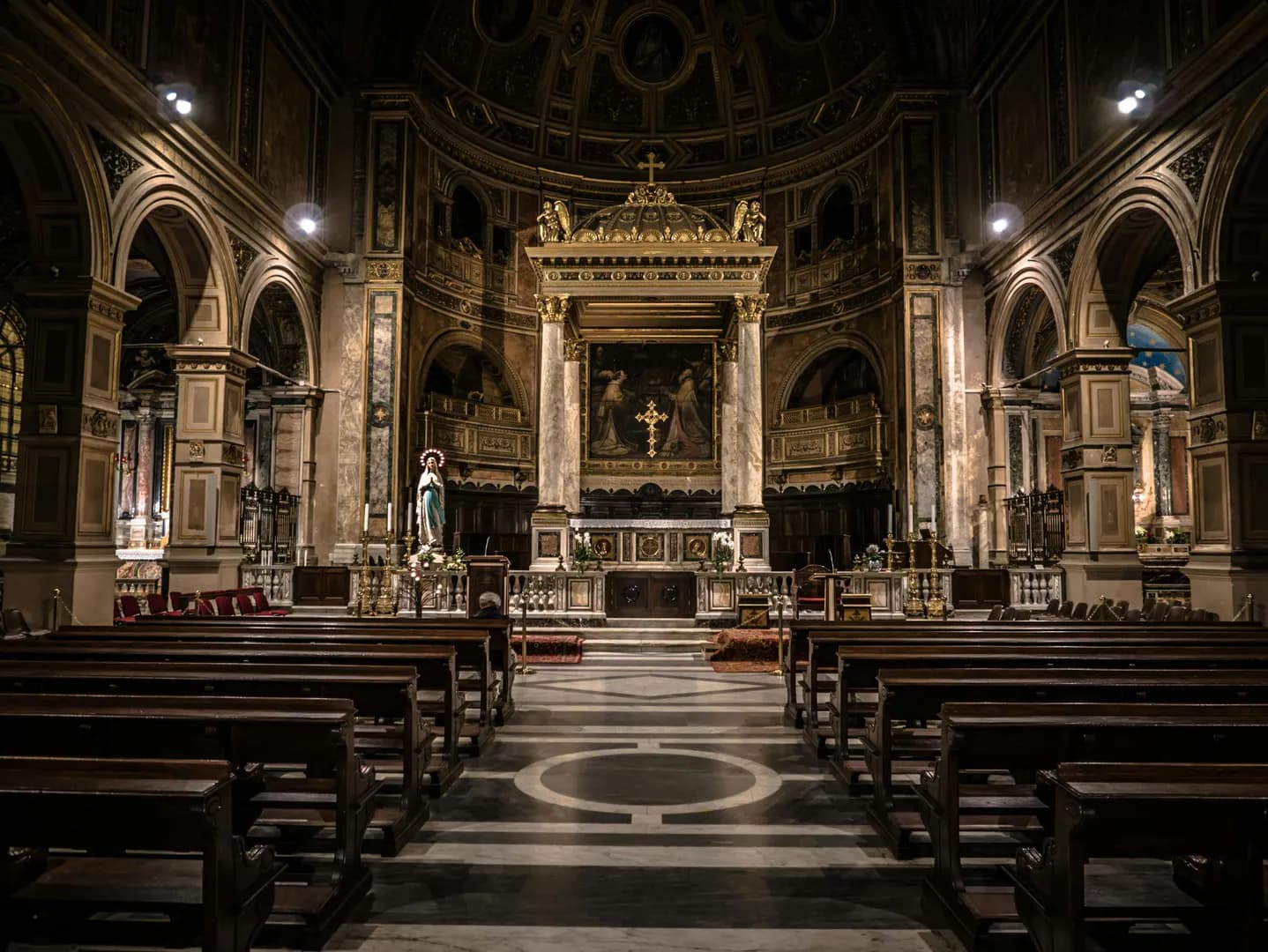
Entering the sanctuary after the dramatic approach, visitors may find the interior initially underwhelming—a relatively modest space that seems insufficient container for the extraordinary setting. This reaction typically reverses upon longer contemplation. The church's power lies not in architectural grandeur but in accumulated devotion: centuries of prayers, thousands of candles, the worn places where pilgrims have knelt and touched and wept.
The miraculous Pietà occupies the central altar, housed in a marble shrine that both protects the statue and creates dramatic focus. The sculpture itself, approximately 70 centimeters in height, depicts Mary holding Christ's body with an expression of grief that transcends cultural boundaries. Regardless of religious belief, visitors often find themselves moved by the raw emotion the anonymous sculptor captured five centuries ago.
The church's walls and ceiling display frescoes and decorative painting from various periods, reflecting centuries of embellishment and restoration. The overall aesthetic leans toward the devotional rather than the artistic—this is a working church, not a museum, and its decoration serves pilgrimage rather than connoisseurship.
Side chapels and alcoves contain votive offerings (ex-votos) left by pilgrims grateful for answered prayers: crutches, medical prosthetics, military medals, photographs, handwritten testimonies. These objects, often naïve in their expression, constitute perhaps the most moving element of the sanctuary—tangible evidence of real suffering and real faith accumulated over generations.
The Terrace and Views
The terrace outside the church offers what many visitors consider the sanctuary's true reward: views that extend across the Adige Valley to distant mountains, with the vertigo-inducing drop creating constant awareness of the setting's impossibility. On clear days, the vista encompasses Verona's surrounding hills, Lake Garda's eastern shore, and Alpine peaks to the north.
This terrace provides space for reflection that the church interior, especially when crowded, may not allow. Many visitors spend more time here than inside, absorbing the location's drama, photographing the seemingly impossible conjunction of architecture and geology, or simply sitting in contemplative silence.
The cliff face above and around the sanctuary reveals the scale of human effort required to create this space—carving, reinforcing, and maintaining structures where rock surfaces offer neither foundation nor shelter. The ongoing battle against erosion, weathering, and gravity continues; scaffolding and conservation works are frequent visitors to this improbable site.
Practical Information
Getting to Madonna della Corona
The sanctuary is located approximately 45 kilometers north of Verona, in the commune of Ferrara di Monte Baldo. Access options include:
By car from Verona: Take the A22 autostrada north toward Trento, exiting at Affi. Follow signs for Spiazzi and Madonna della Corona. The tunnel access provides direct approach to parking areas near the sanctuary. Total driving time approximately 45 minutes.
By car from Lake Garda: From the eastern shore towns (Bardolino, Garda, Lazise), follow signs inland toward Monte Baldo. The sanctuary lies approximately 30-40 minutes from lakeside destinations.
Public transportation: Limited bus service connects Verona to Caprino Veronese, from where taxi or pre-arranged transport reaches Spiazzi. The limited connections make car rental advisable for visitors without vehicles.
Walking from Brentino Belluno: Those seeking the traditional pilgrim experience can leave vehicles in Brentino (lower valley) and walk the historic path (approximately 90-120 minutes ascending, 60-90 minutes descending).
When to Visit
The sanctuary opens daily year-round, though, as with travel in Italy generally, winter hours are reduced and weather may affect access:
Summer (April-October): 7:00-19:30 Winter (November-March): 8:00-18:00
Mass is celebrated multiple times daily, with schedule variations for Sundays and holy days. Those wishing to attend services should consult the current schedule on the sanctuary's website.
Best timing: Early morning visits avoid crowds and provide optimal light for photography, with morning mist often filling the valley below. Late afternoon offers dramatic lighting as the sun descends toward Lake Garda. Midday, especially on summer weekends, brings maximum congestion.
Weather considerations: The exposed position means conditions can differ dramatically from valley or lakeside temperatures. Bring layers even in summer, and be prepared for wind. In winter, ice and snow can affect both access roads and walking paths.
Combining with Other Destinations
Madonna della Corona fits naturally into Lake Garda and Verona itineraries:
From Lake Garda: Combine morning sanctuary visit with afternoon lakeside exploration. The eastern shore towns of Garda, Bardolino, and Lazise lie within 30 minutes.
With Monte Baldo: The cable car from Malcesine ascends Monte Baldo's summit, offering alternative perspectives on the landscape the sanctuary occupies. A full day might include morning at the sanctuary, lunch in Malcesine, and afternoon Monte Baldo exploration.
With Verona: The city makes an obvious pairing, with sanctuary visits in morning or late afternoon and Verona's Arena, old town, and Romeo-and-Juliet attractions filling the remaining hours. Travelers with more time can extend the trip further into the region with our five-day Veneto itinerary.
With Valpolicella: The wine country northwest of Verona offers cellar visits, tastings, and lunch opportunities that complement the sanctuary's spiritual atmosphere with worldly pleasures.
Visitor Etiquette
As a functioning sanctuary welcoming half a million visitors annually, Madonna della Corona maintains certain expectations:
- Dress appropriately: Shoulders and knees should be covered when entering the church. Wraps or shawls are available if needed.
- Maintain silence inside the church, or speak only in whispers.
- Photography is permitted in most areas but may be restricted during services. Flash photography is discouraged.
- The terrace is appropriate for normal conversation and photography.
- Religious services take priority; visitors should step aside or remain respectfully quiet during masses and prayers.
The Meaning of Impossibility
Architecture as Devotion
Madonna della Corona belongs to a tradition of sacred architecture that deliberately courts impossibility. From the rock-hewn churches of Lalibela to the cliff monasteries of Meteora, religious communities have repeatedly chosen to build where building seems inadvisable—not despite the difficulty but because of it. The labor itself becomes prayer; the improbability becomes proof of devotion.
This tradition reflects a theological intuition: that sacred space must be earned, that proximity to the divine requires extraordinary effort, that transformation demands passage through difficulty. The pilgrim climbing the ancient path to Madonna della Corona participates in this understanding, even if the conscious mind dismisses the theology. The body knows what the brain denies—that this arrival is different from driving to a parking lot, that the sanctuary means more for having been reached through exertion and time.
The View from Below
Perhaps the most profound experience of Madonna della Corona comes not at the sanctuary itself but from the valley below. Driving along the Adige, travelers suddenly glimpse the white church hundreds of meters overhead, impossibly attached to vertical rock. The reaction is nearly universal: astonishment, followed by the urgent need to understand how.
This glimpse—brief, unexpected, challenging to comprehension—captures something essential about the sacred. The sanctuary insists on itself, demands attention, refuses to be ignored or normalized. It does not accommodate the viewer; it exists on its own terms, in its own impossible space, whether anyone looks or not.
In an era when photographs circulate endlessly and extraordinary places become familiar through repetition, Madonna della Corona retains the power to astonish. The image prepares visitors for the cliff church; nothing prepares them for the actual experience of standing on that terrace, looking down at the drop, looking up at the rock, absorbing the reality of this place that should not exist but does—has for centuries, will for centuries more, anchored to the mountainside by faith and engineering and the accumulated determination of those who would not accept that some places are simply too difficult to build.
Frequently Asked Questions
Is Madonna della Corona worth visiting if I'm not religious?
The sanctuary rewards visitors regardless of religious belief. The architectural achievement, the dramatic setting, the valley views, and the historical significance all provide meaningful experience independent of faith. Many visitors are drawn primarily by the visual spectacle and find themselves unexpectedly moved by the atmosphere of accumulated devotion.
How difficult is the walking path from Brentino Belluno?
The path presents moderate difficulty: 2.5 kilometers with approximately 600 meters of elevation gain. Reasonably fit visitors without health issues can complete the ascent in 90-120 minutes. The path is paved with stone, not technically challenging, but the gradient requires cardiovascular effort. Those with mobility limitations should use the road/tunnel access instead.
Can I visit Madonna della Corona with children?
Yes, families regularly visit. The tunnel access eliminates the challenging walk for those with young children. The terrace views and the story of the miraculous statue often engage children's imagination. However, the vertical drops require careful supervision of young children, and the church interior demands quiet that some children find challenging.
Is there food available near the sanctuary?
A small bar/restaurant near the parking area provides basic refreshments. More substantial dining options exist in Spiazzi (above) and Brentino Belluno (below). Those walking the traditional path should carry water and snacks.
How long should I allow for a visit?
A minimum of 90 minutes allows time to explore the church, terrace, and views. Those walking the traditional path should add 2-3 hours for ascent and descent. Half a day provides comfortable time for the full experience; those combining with nearby attractions might allocate a full day to the area.
Is the sanctuary crowded?
Summer weekends and religious holidays bring significant crowds. Weekday mornings, especially outside July-August, offer much quieter experiences. Major Catholic feast days (particularly September 15, the Feast of Our Lady of Sorrows) attract large pilgrimages.
References
- Santuario Madonna della Corona. "History and Architecture: Official Guide." Spiazzi, 2022.
- Italian Ministry of Culture. "Religious Tourism Statistics: Veneto Region 2023." ENIT Report, 2024.
- Coltri, G. "La Madonna della Corona: Origini e Leggende." Edizioni Verona, 1987.
- Bertoldi, F. "Dating and Attribution of the Madonna della Corona Pietà." Art History Quarterly, 2008.
- Trecca, G. "Il Restauro del Santuario della Madonna della Corona." Architectural Records, Verona Archives, 1899.
- Santuario Madonna della Corona. "Restoration Report 1985-1988." Technical Documentation, 1989.
- Bonente, R. "Via Crucis: Artist Statement and Technical Notes." Santuario Archives, 1947.