
Stretching fifty kilometers from the Alpine foothills of Trentino to the Venetian plains, Lake Garda defies easy categorization—part Mediterranean paradise, part mountain lake, part Roman ruin, part modern resort, yet somehow cohering into a destination that has enchanted travelers since antiquity.
Italy's Inland Sea
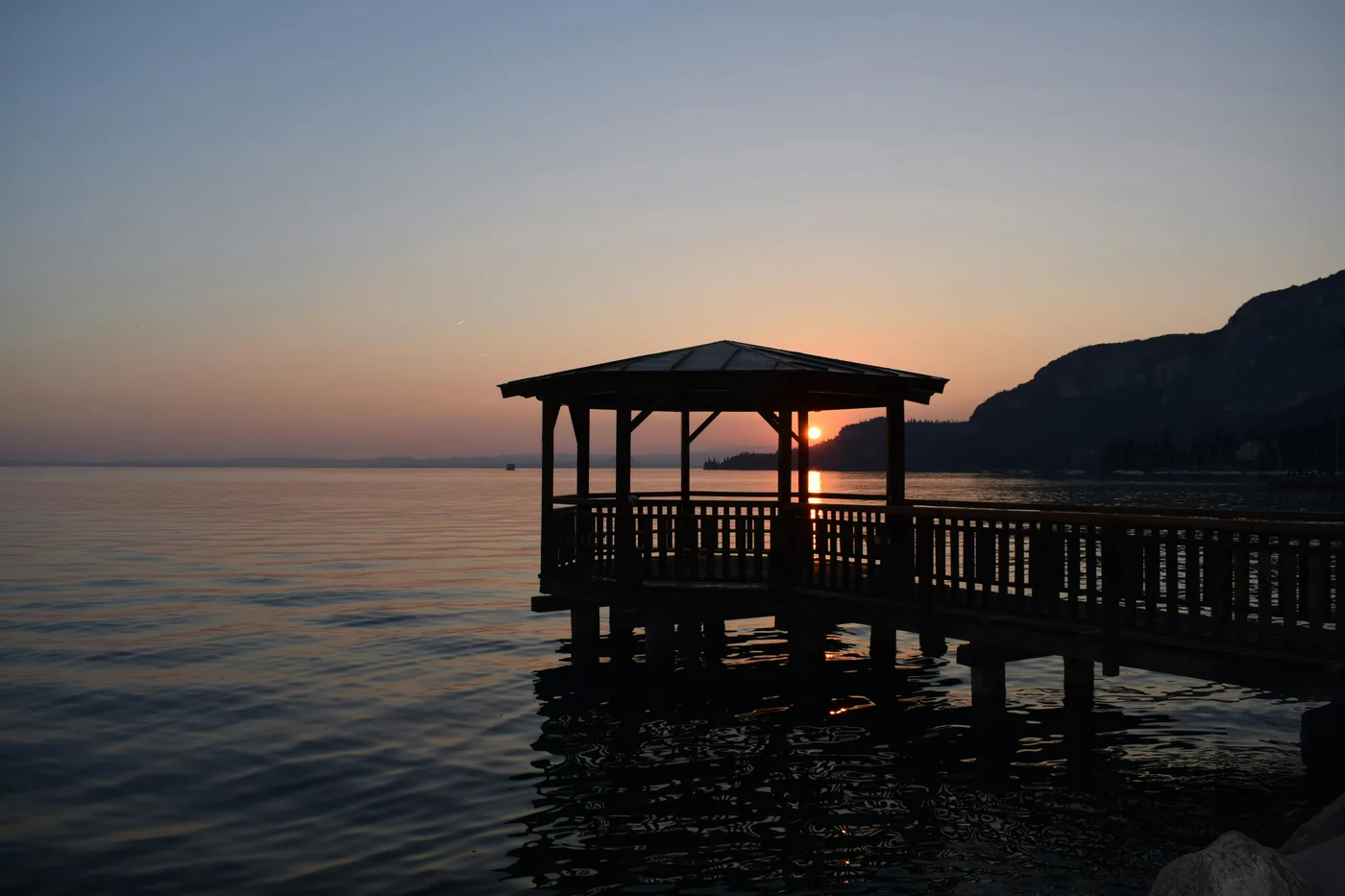
Lake Garda (Lago di Garda, or Benaco in classical Latin) is quite simply enormous. At 370 square kilometers, it is Italy's largest lake, and its maximum depth of 346 meters makes it one of the deepest in Europe.1 These statistics, however, convey nothing of the lake's extraordinary character—its ability to feel intimate despite its scale, to shift personality as one travels from shore to shore, to accommodate both package tourists and discerning travelers within the same remarkably diverse ecosystem.
The lake occupies a glacially carved valley that once extended far south into the Po Plain. When the last ice age ended approximately 10,000 years ago, the retreating glacier left behind a moraine dam at Peschiera, impounding the waters that now fill this enormous basin. The result: a deep northern section where the lake resembles a Norwegian fjord, narrow and dramatic, bracketed by mountains rising directly from the water; and a broad southern section where gentle hills, olive groves, and vineyards create a Mediterranean atmosphere incongruous with the Alpine peaks visible on the northern horizon.2
This duality—Alpine north, Mediterranean south—defines the Garda experience. The same day can include morning coffee in a village where German is spoken as commonly as Italian, a lunchtime drive past lemon terraces impossibly situated on vertical cliffs, and an afternoon walk through Roman ruins in a town that could be transplanted to Tuscany without visual contradiction. Three regions (Trentino-Alto Adige, Lombardy, and Veneto) share the shoreline, each contributing distinct character.
The Northern Lake: Drama and Adventure
Riva del Garda
At the lake's northern tip, Riva del Garda marks the boundary between water and mountain with dramatic finality. Cliffs rise hundreds of meters directly behind the town, channeling winds that make this the Mediterranean's premier inland windsurfing and sailing destination. The harbor fills with sleek craft each summer, their crews exploiting the Peler (morning northerly) and Ora (afternoon southerly) that blow with clock-like reliability during warm months.3
The town itself presents a handsome Austrian-Italian hybrid—memories of centuries under Habsburg rule evident in architecture, municipal planning, and the quality of local pastry. The central Piazza III Novembre, anchored by the 13th-century Torre Apponale, opens directly onto the harbor where ferries connect Riva to destinations throughout the lake.
Inland from the eastern shore, the cliff-hung Sanctuary of Madonna della Corona makes a dramatic half-day excursion for travelers based on the lake. Beyond water sports, Riva offers access to the surrounding mountains. The Via Ferrata Sentiero della Pace (Path of Peace) traverses World War I positions along ridgelines with extraordinary views. The Cascata del Varone, a waterfall accessible via tunnels carved through rock, demonstrates the hydraulic forces shaping this dramatic landscape.
Limone sul Garda
Clinging to impossibly steep terrain on the western shore, Limone sul Garda takes its name either from the citrus that once flourished here or from the Latin limen (boundary)—depending on which local historian you believe.4 Whatever the etymology, lemons did indeed grow here until the late 19th century, sheltered by elaborate terraced structures called limonaie that remain the village's most distinctive feature.
These terraced gardens, with their white pillars designed to support winter protective covering, created a microindustry shipping fruit throughout Europe. The opening of the Brenner railway and competition from Sicily ended commercial viability, but several limonaie have been preserved, offering visitors glimpse of agricultural ingenuity at its most dramatic.
Modern Limone divides opinions. The lakefront, with its pedestrian promenade and cafes, achieves genuine charm. The narrow streets climbing the hillside preserve medieval scale. But the sheer volume of day-trippers arriving by ferry and the resulting souvenir-shop density can overwhelm during peak season. Visit early morning, stay overnight, or come in shoulder season to experience the Limone that earned its fame.
Malcesine and Monte Baldo
The eastern shore's star attraction, Malcesine combines a perfectly preserved medieval center with access to Monte Baldo's extraordinary heights. The Castello Scaligero, perched on a lakefront promontory, has guarded this strategically important position since the 13th century. Goethe, visiting in 1786, was briefly detained here on suspicion of spying—his sketching of the fortress apparently raised alarm.5
The rotating cable car ascending Monte Baldo (1,760m) provides the day's most memorable experience. As the cabin climbs above the lake, it rotates 360 degrees, ensuring all passengers receive panoramic views of water, mountains, and—on clear days—the distant Dolomites. At the summit, hiking trails, mountain biking routes, and paragliding launches await. The mountain's remarkable biodiversity, preserving species that survived the ice ages in this refugium, has earned it the nickname "Garden of Europe."6
The Western Shore: Elegance and Citrus
Gargnano
If overtourism concerns you elsewhere on the lake, Gargnano offers respite. This quiet town, stretching along the water south of Limone, maintains working-harbor authenticity increasingly rare on Garda's shores. Local fishing boats still launch at dawn; waterfront restaurants serve their catch without fanfare.
D.H. Lawrence lived in Gargnano from 1912-1913, writing Twilight in Italy and completing early work on Sons and Lovers. The Villa Igea, where he stayed, remains private, but the atmosphere he described—"a little steamer was threading across the blue water, with its tail of smoke"—persists in quieter moments.7
The town's limonaie exceed even Limone's in scale, while the churches of San Francesco and San Giacomo preserve medieval frescoes that justify detours. Gargnano serves as an excellent base for exploring the western shore without surrendering to tourist intensity.
Gardone Riviera and Il Vittoriale
The elegance that once drew European aristocracy to Garda's western shore survives most visibly at Gardone Riviera. Grand hotels, botanical gardens, and lakefront promenades create an atmosphere of established sophistication far from the bustle of larger resorts.
The town's essential visit is Il Vittoriale degli Italiani, the extraordinary estate of Gabriele d'Annunzio. This poet, soldier, and proto-fascist transformed nine hectares of hillside into a monument to his own ego, accumulating objects, designing theatrical spaces, and eventually embedding an actual warship prow into the hillside.8
Whether one admires d'Annunzio or finds him appalling—most visitors experience both reactions—Il Vittoriale fascinates. The main house, crammed with artifacts and designed to exclude natural light (d'Annunzio claimed photophobia), creates claustrophobic intensity. The gardens, offering respite and stunning views, demonstrate genuine landscape artistry. The open-air theater hosts summer concerts in extraordinary setting.
Salò
The largest town on the western shore, Salò achieved unwelcome historical fame as the seat of Mussolini's puppet government (the Repubblica Sociale Italiana) from 1943-1945. That dark chapter receives thorough documentation at the MuSa museum, which contextualizes the period within Salò's longer history.9
Modern Salò offers excellent shopping along its lengthy lakefront promenade, the Renaissance cathedral of Santa Maria Annunziata, and ferry connections throughout the lake. As the western shore's service center, it makes a practical base for travelers preferring urban amenities to village intimacy.
The Southern Lake: Romance and History
Sirmione
Jutting two kilometers into the lake on a narrow peninsula, Sirmione delivers Garda's most concentrated dose of romance and history. The town entrance requires passage through the moated Castello Scaligero, one of Italy's best-preserved medieval fortresses, its crenellated walls rising directly from the water.10
Beyond the castle, narrow streets thread past boutiques, gelaterias, and restaurants to the peninsula's tip, where the Grotte di Catullo preserve substantial remains of a Roman villa. Despite the name (caves of Catullus), the structure postdates the poet who praised this place—but the ruins, spreading across olive-shaded hectares with lake views in every direction, create atmosphere worthy of any literary association.11
Sirmione's thermal springs, exploited since Roman times, feed modern spa facilities including the Aquaria thermal baths at the castle's base. The sulfurous waters, emerging at 69°C, serve both therapeutic and hedonistic functions—outdoor pools allow bathing while gazing at medieval walls and mountain backdrops.
The town's popularity creates significant congestion, particularly on summer weekends when vehicle access is restricted and ferry queues extend significantly. Early arrival, weekday visits, or shoulder-season timing improves the experience considerably.
Desenzano del Garda
The southern shore's largest town serves as Garda's transportation hub, with direct train service to Milan, Venice, and Verona making it the obvious access point for visitors without cars. The town rewards exploration beyond its practical functions: a substantial old quarter, Roman villa mosaics, the Duomo containing a Last Supper by Tiepolo, and a lakefront passeggiata that comes alive on summer evenings.
Peschiera del Garda
A UNESCO World Heritage Site as part of the "Venetian Works of Defence," Peschiera presents a star-shaped fortress surrounding a complete historic center.12 The Venetians fortified this position controlling the Mincio River outflow with characteristic thoroughness; the resulting walls, bastions, and moats remain intact and atmospheric.
Modern Peschiera serves as the gateway to Gardaland, Italy's largest amusement park, and the numerous family-oriented attractions clustered in the southern lake area. The town itself maintains genuine character within its walls—quiet canals, fish restaurants, the sense of inhabiting a preserved past.
The Eastern Shore: Wine and Quiet Waters
Bardolino and the Wine Road
The Veneto shore between Peschiera and Malcesine presents gentler terrain—rolling hills rather than cliffs, vineyards rather than lemon terraces. This is wine country, home to Bardolino DOC (crisp, cherry-scented reds) and the Lugana DOC (elegant whites from Turbiana grapes grown in the clay-rich southern soils).13
The town of Bardolino, while touristy, offers genuine wine culture: numerous enotecas, a wine museum, and surrounding estates welcoming tasting visitors. The October Festa dell'Uva e del Vino (Grape and Wine Festival) provides local immersion for those timing permits.
Lazise
The perfectly preserved medieval walls of Lazise create one of Garda's most photogenic port scenes—pleasure craft moored in harbor, castle tower beyond, cafes lining the waterfront. The town achieved remarkable early independence, receiving from Emperor Otto II in 983 what may be Italy's first municipal charter.14
Modern Lazise maintains this sense of confident identity despite tourist numbers. The old town preserves its integrity; the Monday market, sprawling along the harbor promenade, remains primarily local rather than tourist-oriented; evening passeggiata flows naturally without artificial attraction.
Garda Town
The lake takes its name from this settlement, though modern Garda town makes no particular claim to primacy. What it offers is an excellent beach, a pleasant if unremarkable old quarter, and access to the dramatic rock headland of Rocca del Garda, where the fortified hermitage of San Giorgio surveys the lake from spectacular elevation.
Practical Planning
Getting There and Around
By Train: Desenzano del Garda and Peschiera del Garda have stations on the Milan-Venice line, with journey times of approximately 25 minutes from Verona, 90 minutes from Milan, and 90 minutes from Venice. High-speed services stop at Desenzano.
By Air: Verona's Valerio Catullo Airport lies 15 kilometers from the lake; Milan's Bergamo (Orio al Serio) and Linate airports offer additional options with good ground connections.
By Car: The A4 motorway passes along the southern shore; exit at Peschiera, Sirmione, Desenzano, or Brescia Est depending on destination. Northern lake destinations are reached via the SS45bis from Trento or the SS249 from Verona.
On the Lake: Navigazione Lago di Garda operates an extensive network of ferries and hydrofoils connecting all significant lakeside communities. Services run year-round, with dramatically increased frequency from Easter through October. Multi-day passes offer significant savings for intensive use.
By Bus: Local services connect lakeside towns, though schedules can be limited, particularly on the western shore.
When to Visit
Summer (June-August): Peak season brings warm water, full services, and substantial crowds. Italian school holidays (mid-June to mid-September) intensify pressure. Northern lake resorts may feel overwhelmed; southern destinations become extremely congested on weekends.
Shoulder Season (April-May, September-October): As with most of the country, this window is perhaps ideal, with swimmable water (at least in September), pleasant temperatures, operating services, and manageable visitor numbers. Spring brings wildflowers to Monte Baldo; autumn adds harvest atmosphere to wine country.
Winter (November-March): Many lakeside businesses close, ferries run reduced schedules, and the atmosphere shifts dramatically—quieter, more local, sometimes strikingly moody when mists rise from the water. Sirmione's thermal facilities operate year-round; Riva maintains activity due to its urban scale. The northern lake receives less sunshine but dramatic mountain views.
Where to Stay
Accommodation options span every category and price point. General guidance:
For atmosphere and romance: Sirmione, Gardone Riviera, or Gargnano For water sports and mountain access: Riva del Garda or Malcesine For family activities: Peschiera del Garda (Gardaland proximity) or Lazise For wine exploration: Bardolino or the eastern shore villages For transportation convenience: Desenzano del Garda
Booking well in advance is essential for summer visits, particularly in popular towns like Sirmione and Malcesine where accommodation is limited.
What to Eat and Drink
Lake fish appear throughout Garda menus—carp, tench, pike, and sardines (the latter actually a local freshwater species, Alburnus arborella, not the marine fish). Preparations range from simple grilling to elaborate medieval-recipe stews.
The olive oil produced on Garda's shores—particularly the western shore's Olio DOP Garda—ranks among Italy's finest, with delicate flavors distinct from Tuscan counterparts. Tasting opportunities abound; the oil makes excellent souvenir.
Local wines deserve attention: light, food-friendly Bardolino; elegant white Lugana; rare Groppello rosé from the western shore. The Veneto shore's proximity to Valpolicella brings Amarone and Ripasso within easy exploration.
The Garda Experience
Finding Your Garda
Lake Garda's size and diversity mean that different travelers experience essentially different destinations. The windsurfer staying in Riva inhabits a different Garda than the spa-seeker soaking in Sirmione's thermal waters. The family navigating Gardaland queues shares little with the wine enthusiast tasting Lugana in quiet cantinas.
This multiplicity constitutes Garda's particular genius. The lake accommodates varied motivations without forcing interaction. Travelers seeking sophisticated quiet find it at Gargnano; those wanting buzz and nightlife head to Desenzano. History awaits at Roman ruins and Scaligero castles; adventure beckons from Monte Baldo's heights. One could visit repeatedly, exploring different shores and purposes, and never exhaust the possibilities.
Beyond Checklist Tourism
Like all famous destinations, Garda can be reduced to checklist items: Sirmione's castle, Limone's view, Malcesine's cable car. These experiences merit attention, but the lake rewards those who linger beyond the obvious—accepting ferry schedules as invitations to patience rather than inconveniences, wandering backstreets where tourists don't venture, timing visits to catch morning light on water or evening reflections of mountain silhouettes.
The ancient Romans understood this. They built villas here not for specific attractions but for the quality of light and air, the therapeutic waters, the sense of escape that the lake has always provided. Catullus praised "Sirmio, the gem of peninsulas and islands"—not for any particular feature but for the accumulated grace of its setting.15
That grace persists. Despite development, commercialization, and tourist pressure, Lake Garda retains the capacity to enchant. The mountains still reflect in morning stillness. The afternoon ora still fills sails. The evening light still transforms ordinary views into paintings. Two thousand years of visitors have not exhausted what this remarkable lake offers, and neither will you.
Frequently Asked Questions
How many days do I need for Lake Garda?
A minimum of three days allows meaningful exploration of one section—north or south—with day trips to the other. A week permits thorough coverage of major sites with time for relaxation. The lake rewards repeated visits focused on different areas or activities.
Which is the best town to stay in on Lake Garda?
No single answer suits all travelers. Sirmione offers history and romance but significant crowds. Riva del Garda provides mountain access and northern atmosphere. Gargnano balances charm with tranquility. Desenzano offers best transportation connections. Consider priorities when choosing.
Is Lake Garda suitable for families with children?
Excellent family facilities include Gardaland and related theme parks, numerous beaches with gradual entry, ferry excursions, and mountain adventures at Monte Baldo. The southern lake, with its calmer waters and concentrated attractions, suits families particularly well.
Can I swim in Lake Garda?
Yes, swimming is popular from June through September, with water temperatures reaching 24-25°C in summer. Numerous beaches—both free public and paid lido—line all shores. The southern lake warms faster; the deep northern waters remain cooler longer.
What's the best way to get around Lake Garda?
The ferry system provides the most atmospheric transport, connecting all significant towns with reasonable frequency. Cars offer flexibility but face congestion and parking challenges in popular towns. A combination—strategic car use plus ferry day trips—works well for many visitors.
Is Lake Garda expensive?
Prices vary significantly by location and season. Sirmione and northern resort towns command premium rates; less famous eastern shore villages offer better value. Shoulder seasons bring dramatic price reductions. Self-catering accommodation and picnic lunches stretch budgets effectively.
References
- Salmaso, N. & Mosello, R. "Limnological Research on the Deep Southern Subalpine Lakes: Synthesis, Directions and Perspectives." Advances in Oceanography and Limnology, 2010.
- Ravazzi, C. "Late Quaternary History of Spruce in Southern Europe." Review of Palaeobotany and Palynology, 2002.
- Cantoni, B. "Wind Systems of Lake Garda and Their Role in Sailing." Italian Journal of Meteorology, 2015.
- Maratini, G. "Limone sul Garda: Storia e Tradizioni." Edizioni del Garda, 2012.
- Goethe, J.W. "Italian Journey." Translated by W.H. Auden and Elizabeth Mayer. Penguin Classics, 1970.
- Prosser, F. "Flora del Monte Baldo." Museo Civico di Rovereto, 2008.
- Lawrence, D.H. "Twilight in Italy." Duckworth, 1916.
- Fondazione Il Vittoriale degli Italiani. "Official Guide." Gardone Riviera, 2021.
- MuSa Museo di Salò. "The Italian Social Republic: Historical Documentation." Salò, 2019.
- Varanini, G.M. "I Castelli Scaligeri." Cierre Edizioni, 2005.
- Roffia, E. "Le Grotte di Catullo a Sirmione." Soprintendenza Archeologica della Lombardia, 2014.
- UNESCO World Heritage Centre. "Venetian Works of Defence." World Heritage List Documentation, 2017.
- Consorzio Tutela Vino Bardolino. "Bardolino Wine: Territory and Tradition." Verona, 2022.
- Comune di Lazise. "Lazise: Eight Centuries of Municipal History." Historical Archives, 2008.
- Catullus. "Poems." Poem 31. Translated by Peter Green. University of California Press, 2005.