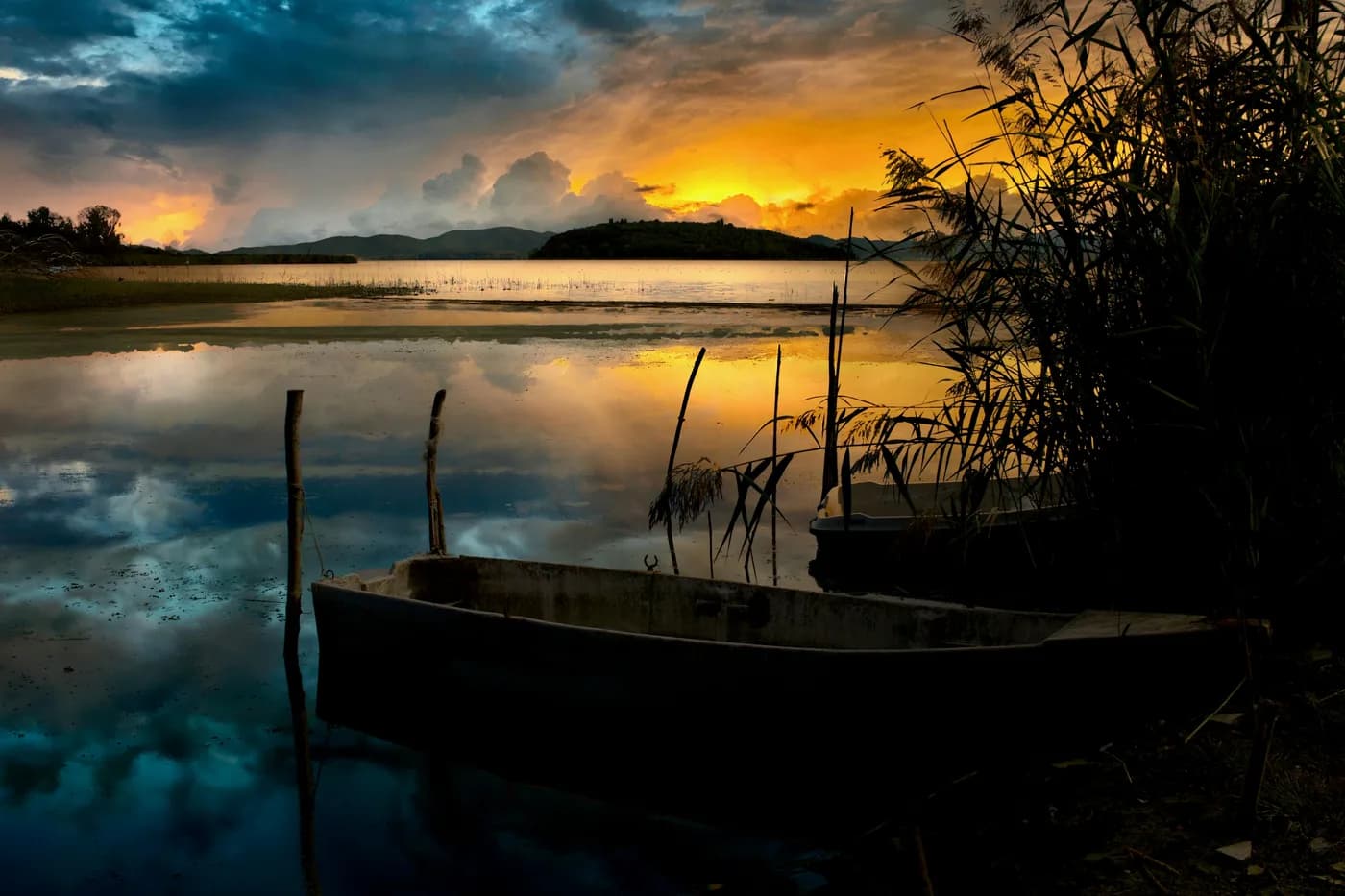

Where the gentle waters of Umbria's largest lake have witnessed Hannibal's triumph, medieval castles have risen and fallen, and fishermen have cast their nets for three millennia, Lake Trasimeno remains one of Italy's most beautifully preserved secrets.
The Heart of Green Umbria
Nestled in the rolling hills of western Umbria, just kilometers from the Tuscan border, Lake Trasimeno (Lago Trasimeno) spreads across 128 square kilometers of shimmering water, making it the fourth-largest lake in Italy and the largest on the Italian peninsula.1 Yet despite its impressive size, this ancient lake remains refreshingly free from the crowds that descend upon its northern cousins, Como and Garda.
The lake's shallow waters—averaging just 4.3 meters in depth with a maximum of only 6 meters—create a unique ecosystem that has sustained human civilization since Etruscan times.2 This shallowness gives Trasimeno its distinctive character: waters that warm quickly under the Umbrian sun, reed beds that shelter countless bird species, and a tranquility that deeper lakes simply cannot match.
For travelers seeking an authentic Italian experience away from tourist infrastructure, Lake Trasimeno offers something increasingly rare: a glimpse of Italy as it existed before mass tourism transformed its most famous destinations. Here, local dialects still pepper conversations in village bars, fishing traditions continue unbroken, and the rhythm of life follows seasons rather than tour bus schedules.
A Lake Steeped in History
The Battle That Changed Rome
On a misty morning in June 217 BCE, the shores of Lake Trasimeno witnessed one of the most devastating defeats in Roman military history. The Carthaginian general Hannibal Barca, having crossed the Alps with his legendary elephants, lured the Roman consul Gaius Flaminius into a carefully prepared ambush along the lake's northern shore.3
Hidden in the hills above the lake, Hannibal's forces waited as the Roman legions marched along the narrow strip between water and mountains. When the trap sprung, approximately 15,000 Roman soldiers perished in just three hours—many drowning in the lake itself as they fled the Carthaginian onslaught.4 The battle site, near modern-day Tuoro sul Trasimeno, remains marked with monuments and an archaeological trail that allows visitors to walk the very ground where history pivoted.
The village of Sanguineto, whose name derives from the Latin word for blood, serves as a permanent reminder of that fateful day. Local legend holds that the lake ran red for three days following the battle, though modern historians attribute this to the disturbed sediments rather than actual blood.5
Etruscan Origins and Medieval Fortifications
Long before Hannibal's arrival, the Etruscans recognized Trasimeno's strategic and economic value. Archaeological evidence suggests continuous habitation around the lake since at least the 8th century BCE, with the Etruscans establishing fishing communities that developed sophisticated techniques still used by local fishermen today.6
The medieval period saw the construction of the fortified towns that now define the lake's character. Castiglione del Lago, Passignano sul Trasimeno, and Magione all developed behind protective walls, their towers and castles commanding views across the water. These towns passed through the hands of various powers—the Papal States, Perugia, and local noble families—each leaving architectural traces that create the rich historical tapestry visitors discover today.
The Three Lakeside Towns
Castiglione del Lago: The Lake's Crown Jewel
Perched on a limestone promontory that was once an island, Castiglione del Lago is widely considered the most beautiful of Trasimeno's towns. Its remarkably intact medieval walls enclose a labyrinth of narrow streets, artisan workshops, and family-run restaurants serving lake fish prepared according to centuries-old recipes.
The town's crowning glory is the Palazzo della Corgna, a 16th-century ducal palace whose frescoed rooms rival those of Florence's more famous palaces.7 Connected to the adjacent Rocca del Leone fortress by a covered walkway, the palazzo offers visitors a journey through Renaissance art and architecture. The fortress itself, with its distinctive triangular layout and five towers, provides panoramic views across the lake to the three islands and the distant Apennine mountains.
What to do in Castiglione del Lago:
- Walk the complete circuit of medieval walls at sunset
- Visit Palazzo della Corgna and its Renaissance frescoes
- Dine on tegamaccio (traditional lake fish stew) at a lakefront restaurant
- Browse the weekly Wednesday market for local olive oil and Umbrian ceramics
- Catch the ferry to Isola Maggiore
Passignano sul Trasimeno: The Active Lakeside
Where Castiglione del Lago offers contemplation, Passignano provides energy. This lively town on the lake's northern shore serves as Trasimeno's water sports hub, with sailing schools, kayak rentals, and a popular lido beach drawing swimmers throughout summer months.
The historic center, though smaller than Castiglione's, rewards exploration with its medieval tower, Romanesque church of San Cristoforo, and waterfront promenade perfect for evening passeggiata. Passignano's strategic position meant frequent conflict throughout history—the town was heavily bombed during World War II, and the subsequent reconstruction created an interesting blend of medieval and mid-20th century architecture.8
The town truly comes alive during the Palio delle Barche, held each July. This unique festival sees teams from the town's four historic districts race across the lake carrying boats on their shoulders—a tradition that combines athletic competition with historical pageantry in ways that feel genuinely local rather than performed for tourists.
Magione: The Pilgrimage Connection
Less visited than its neighbors, Magione offers perhaps the most authentic experience of daily Umbrian life. The town takes its name from a medieval hospice (mansio) established by the Knights of Malta to serve pilgrims traveling between Rome and Assisi.9
The Torre dei Lambardi, a 12th-century tower that once served as a lookout point, now houses a small museum dedicated to local fishing traditions. More compelling for many visitors is the nearby Abbazia di San Salvatore, a Romanesque abbey whose simple stone architecture embodies the spiritual contemplation that has drawn pilgrims to Umbria for centuries.
The Islands of Trasimeno
Isola Maggiore: A Step Back in Time
Of Trasimeno's three islands, only Isola Maggiore maintains a permanent (if dwindling) population. This 24-hectare island, accessible by regular ferry from Castiglione del Lago and Passignano, offers one of Italy's most peaceful escapes.
The island's connection to St. Francis of Assisi draws pilgrims and curious travelers alike. According to tradition, Francis spent Lent of 1211 on Isola Maggiore, fasting in a cave and inspiring the local fishermen with his teachings.10 A small chapel marks the site, and the statue of Francis gazing across the water has become one of Trasimeno's most photographed images.
Walking the island's single paved path—vehicles are prohibited—visitors pass through a village that seems frozen in the 19th century. Once home to over 600 residents, the island now counts fewer than 20 permanent inhabitants, mostly elderly women who continue the tradition of merletto a punto Irlanda, a distinctive form of Irish-style lace introduced by a local noblewoman in the 1904.11
The island's highlight is the ruined Castello Guglielmi, a neo-Gothic castle built in the 1880s by Roman senator Giacinto Guglielmi. Now abandoned and overgrown, the castle and its chapel create an irresistibly romantic scene—crumbling towers against sunset skies, wild gardens reclaiming what human ambition once built.
Isola Polvese: Nature's Domain
The largest of Trasimeno's islands, Isola Polvese is uninhabited and designated as a scientific-educational park. Accessible by ferry from San Feliciano, this 69-hectare island showcases the lake's natural heritage through marked trails, a botanical garden, and the ruins of a 14th-century Olivetan monastery.12
Birdwatchers find particular reward here—the island's protected status and varied habitats support significant populations of herons, cormorants, and migratory species. The fortress at the island's highest point offers commanding views while its interior hosts environmental education programs and occasionally cultural events.
Isola Minore: The Private Isle
The smallest island, Isola Minore, remains privately owned and inaccessible to visitors. Once home to a fishing community, the island was abandoned in the 17th century and now serves primarily as a nesting site for water birds—a fitting final chapter for this peaceful archipelago.
Culinary Traditions of the Lake
The Queen of Trasimeno: Regina in Porchetta
Lake Trasimeno's culinary identity centers on its fish, particularly the regina (queen)—the local name for carp. The signature preparation, regina in porchetta, adapts Umbria's famous pork preparation for lake fish: the carp is stuffed with wild fennel, garlic, and rosemary, then slowly roasted until the skin crisps and the flesh becomes tender and aromatic.13
This dish represents the essence of Umbrian cooking—humble ingredients transformed through technique and patience into something extraordinary. Purists insist that authentic regina in porchetta requires wild fennel gathered from the lake shores, not cultivated substitutes.
Tegamaccio: The Fisherman's Stew
If regina in porchetta represents festive cooking, tegamaccio embodies daily sustenance. This rustic fish stew combines whatever the morning's catch provides—perch, tench, pike, eel—in a terracotta pot with tomatoes, white wine, garlic, and the ever-present wild fennel.
Each lakeside family maintains their own version, handed down through generations. Some add a splash of vinegar for brightness; others include a handful of chili for heat. The common thread is the earthenware pot, which must be properly seasoned through years of use to achieve the correct flavor.
Beyond Fish: Umbrian Excellence
While fish dominates lakefront menus, visitors should not overlook the broader Umbrian table. The region's olive oil ranks among Italy's finest, with the Trasimeno hills producing oils of remarkable depth and peppery finish. Local lentils from nearby Castelluccio, Norcia's famous black truffles, and the wild boar that roam the surrounding forests all appear on restaurant menus.
The wines of nearby Montefalco—particularly Sagrantino, one of Italy's most powerful red grapes—provide perfect accompaniment to Umbrian cuisine. The DOC wines produced around the lake itself, while less celebrated, offer excellent value and genuine local character.
Practical Information for Visitors
Getting to Lake Trasimeno
Lake Trasimeno sits conveniently close to major transportation links. Perugia, Umbria's capital, lies just 30 kilometers east and offers train connections to Rome (2.5 hours) and Florence (2 hours). Several lakeside towns, including Passignano and Castiglione del Lago, have their own train stations on the Foligno-Terontola line.
For those driving, the E45 highway passes near the lake's eastern shore, while the A1 autostrada connecting Florence and Rome runs approximately 30 kilometers to the west. The lake makes an ideal stop for travelers between Tuscany and Rome or as a base for exploring both regions.
When to Visit
Like much of the country, the lake reveals different personalities through the seasons. Summer brings warm water temperatures, active beach scenes, and long evenings on restaurant terraces. However, this is also when Italian families descend for vacations, and accommodation prices peak.
Spring and autumn offer perhaps the ideal balance—pleasant temperatures, blooming or harvest landscapes, and far fewer visitors. The autumn grape and olive harvests provide special opportunities for culinary travelers, while spring wildflowers carpet the surrounding hills.
Winter sees many facilities close, but rewards visitors with dramatic atmospheric conditions—mist rising from the lake, deserted medieval streets, and the kind of profound quiet that has drawn contemplatives to Umbria for centuries.
Where to Stay
Accommodation around Trasimeno ranges from simple agriturismi (farm stays) to elegant lakeside hotels. Castiglione del Lago offers the greatest variety, including several historic properties within the medieval walls. For those seeking immersion in rural life, the farms and country houses scattered through the hills provide authentic experiences and often remarkable value.
The eastern shore, around San Feliciano and Monte del Lago, tends toward quieter, more intimate properties. Here, small family-run establishments often include evening meals featuring the owner's own olive oil, wine, and garden vegetables—the essence of the agriturismo experience.
Why Lake Trasimeno Deserves Your Attention
In an era when overtourism threatens Italy's most beloved destinations, Lake Trasimeno offers something precious: authenticity without compromise. Here, medieval towns remain living communities rather than museum pieces. Fishermen still set out before dawn in traditional boats. Restaurants serve dishes refined over centuries rather than designed for Instagram.
This is not to suggest that Trasimeno rejects visitors—quite the contrary. The lake's communities welcome travelers with genuine Umbrian warmth, eager to share their history, cuisine, and way of life. But they do so on their own terms, at their own pace, confident in traditions that need no modification for tourist consumption.
For travelers willing to slow down, to linger over a plate of tegamaccio as afternoon shadows lengthen, to walk medieval walls without consulting a guidebook, Lake Trasimeno reveals the Italy that many seek but few find. It is a destination that rewards patience, curiosity, and the willingness to embrace a rhythm of life that has sustained these shores for three thousand years.
Frequently Asked Questions
How do I get from Perugia to Lake Trasimeno?
Lake Trasimeno lies approximately 30 kilometers west of Perugia. Regular regional trains connect Perugia to Passignano sul Trasimeno (20 minutes) and Castiglione del Lago (30 minutes). By car, the journey takes about 30 minutes via the E45bis highway. Several bus lines also serve the lake towns, though schedules are less frequent than train service.
Can I swim in Lake Trasimeno?
Yes, swimming is popular throughout the summer months. The lake's shallow, gently warming waters make it particularly suitable for families. Official beaches (lidi) with facilities are found at Passignano, Castiglione del Lago, and San Feliciano. Water quality is monitored regularly and generally excellent, though algae blooms occasionally occur during particularly hot summers.
Is Lake Trasimeno worth visiting in winter?
Winter visits offer a dramatically different but rewarding experience. Many tourist facilities close, but the medieval towns remain atmospheric, restaurant prices drop significantly, and the lake's moody winter landscapes appeal to photographers and those seeking solitude. The weeks around Christmas bring special events and markets, particularly in Castiglione del Lago.
How much time should I spend at Lake Trasimeno?
While the lake can be visited as a day trip from Perugia, Florence, or even Rome, two to three days allows proper exploration of the main towns and at least one island. Travelers interested in deeper immersion—perhaps combining lake time with visits to nearby Cortona, Assisi, Orvieto, or the flower-filled hilltop town of Spello—might happily spend a week using Trasimeno as a base. For a broader look at how the lake fits into the wider region, see our guide to Tuscany or Umbria.
What is the best town to stay in at Lake Trasimeno?
Castiglione del Lago offers the best combination of beauty, atmosphere, and practical services, making it the top choice for most visitors. Passignano appeals to those seeking more activity and nightlife. For maximum tranquility, consider the smaller settlements like San Feliciano or Monte del Lago on the eastern shore.
References
- Dragoni, W. & Valigi, D. "Groundwater and Lake Trasimeno." Hydrological Sciences Journal, 2012.
- Umbria Regional Authority. "Lago Trasimeno: Caratteristiche Morfologiche." Environmental Agency Report, 2020.
- Goldsworthy, Adrian. "The Fall of Carthage: The Punic Wars 265-146 BC." Cassell Military, 2003.
- Daly, Gregory. "Cannae: The Experience of Battle in the Second Punic War." Routledge, 2002.
- Tuoro sul Trasimeno Archaeological Museum. "The Battle of Lake Trasimeno: Historical Documentation." Municipal Exhibition, 2017.
- Bruschetti, Paolo. "Gli Etruschi e il Trasimeno." Soprintendenza per i Beni Archeologici dell'Umbria, 2009.
- Italian Ministry of Culture. "Palazzo della Corgna: Official Guide." MiBAC Publications, 2018.
- Passignano Historical Society. "La Ricostruzione Postbellica 1945-1960." Local History Archives, 2005.
- Order of Malta Historical Commission. "Medieval Hospices of the Italian Pilgrimage Routes." Rome, 2011.
- Franciscan Sources. "The Legend of Perugia: Francis at Lake Trasimeno." Edited by R. Armstrong, 2000.
- Morroni, Elena. "Il Pizzo d'Irlanda dell'Isola Maggiore." Textile History Review, 2014.
- Umbria Regional Park Authority. "Isola Polvese Scientific Park: Management Plan." Environmental Report, 2019.
- Slow Food Foundation. "Presidi Slow Food: Regina in Porchetta del Trasimeno." Biodiversity Archive, 2016.