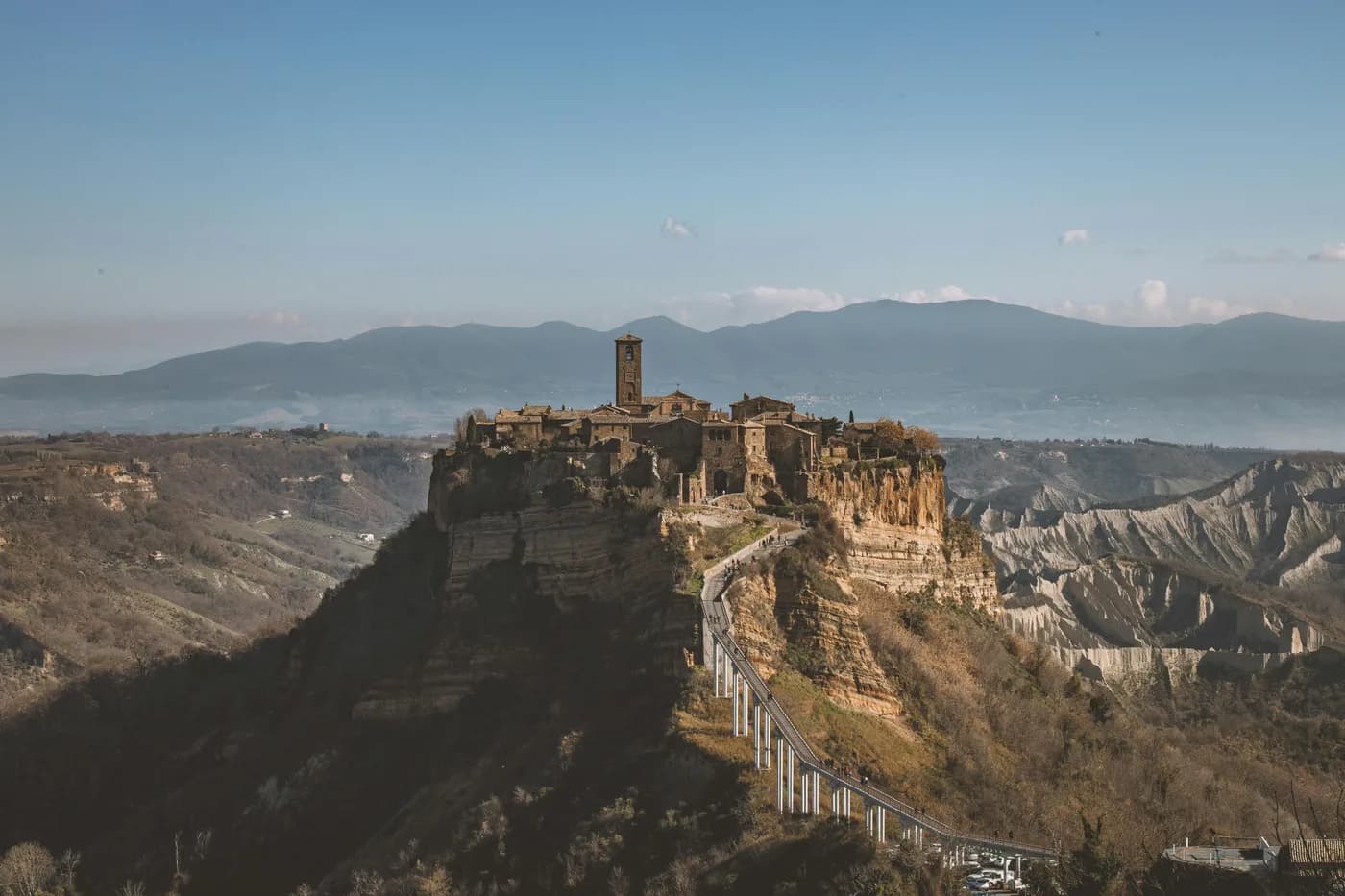

Rising from the morning mist like a vision from a Renaissance painting, Civita di Bagnoregio clings to its eroding pedestal of volcanic rock—a village that has been "dying" for centuries yet refuses to surrender its extraordinary beauty.
The City That Refuses to Die
There is a moment, usually in early morning or late afternoon, when Civita di Bagnoregio transcends mere destination and becomes something approaching religious experience. As fog fills the surrounding valleys, the ancient village appears to float above the clouds, its medieval towers and terracotta roofs suspended in a silver sea. It is in these moments that visitors understand why Italians call this place "La città che muore"—the dying city—and why that poetic epithet only begins to capture its haunting magnificence.
Civita sits atop a plateau of volcanic tuite formed approximately 300,000 years ago by eruptions from the nearby Vulsini volcanic complex.1 This same geological foundation that created such dramatic beauty now threatens its survival. The soft tufa rock erodes continuously, carved away by wind, rain, and the seismic activity that periodically shakes this corner of central Italy. Each year, a few more centimeters crumble into the surrounding canyons—a geological death sentence that has been executing itself for millennia.
Yet Civita endures. Its population, which once numbered in the thousands, has dwindled to somewhere between seven and twelve permanent residents, depending on the season and who's counting.2 These stalwart inhabitants—mostly elderly, deeply attached to their ancestral home—represent the living heart of a village that tourism statistics and geological reports might otherwise dismiss as a beautiful corpse.
Twenty-Five Centuries of History
Etruscan Foundations
Long before Rome rose to prominence, the Etruscans recognized the defensive advantages of Civita's isolated plateau. Archaeological evidence suggests settlement here as early as the 7th century BCE, with the Etruscans carving tunnels, tombs, and storage chambers into the soft tufa that still honeycomb the rock beneath the village.3
The most significant Etruscan legacy lies beneath the church of San Donato, where a tunnel known as the "Bucaione" descends through the bedrock. Originally an Etruscan drainage system, this engineering marvel prevented water accumulation that would have accelerated erosion—a 2,500-year-old infrastructure project that continues to protect the village today.
The Etruscans also created the strada tagliata, roads literally cut through solid rock, several of which remain visible in the surrounding valleys. These deep channels, worn smooth by countless feet and hooves over centuries, offer visceral connection to the ancient peoples who first recognized this plateau's potential.
Medieval Transformation
Following the Etruscan decline and Roman period, Civita emerged as a medieval stronghold of considerable importance. The village became the seat of a bishopric, commanding religious and political influence throughout the surrounding territory. The Romanesque church of San Donato, rebuilt in the 7th century and modified repeatedly thereafter, served as cathedral for a diocese that encompassed numerous surrounding communities.4
The medieval period also saw construction of the defensive walls and towers that still define Civita's silhouette. The main gateway, flanked by a Renaissance arch added in the 16th century and originally accessed by drawbridge, demonstrates the military thinking that shaped the village—though the greatest threat always came not from invaders but from the crumbling ground beneath.
In 1695, a catastrophic earthquake devastated the region, destroying the land bridge that connected Civita to the larger town of Bagnoregio and beginning the village's long isolation.5 From that moment, Civita became an island surrounded not by water but by air—accessible only by foot along precarious paths that would eventually be replaced by the pedestrian bridge visitors use today.
The Slow Decline
The earthquake that severed Civita's connection to the mainland initiated a gradual exodus that continues to this day. Without easy access, commerce withered. The bishop relocated to Bagnoregio. Young people left for cities offering opportunity that a dying village could not provide. Houses stood empty, their roofs collapsing, their gardens returning to wilderness.
By the mid-20th century, Civita seemed destined for complete abandonment. A handful of elderly residents remained, tending small gardens, maintaining traditions, watching their neighbors depart one by one. The village that had survived Etruscan kings, Roman emperors, medieval warfare, and centuries of earthquakes appeared finally ready to surrender to time.
Renaissance Through Tourism
The salvation, ironically, came from the very quality that seemed to doom Civita: its dramatic inaccessibility. Beginning in the 1960s, writers and photographers began celebrating the village's melancholy beauty. The architecture critic Bruno Zevi championed preservation efforts.6 Artists established studios in abandoned houses. Gradually, the world discovered that decay itself could be beautiful—that watching something die could inspire rather than depress.
Today, Civita welcomes over one million visitors annually, a number that would have seemed inconceivable to the residents who weathered the lean years of near-abandonment.7 This tourism, carefully managed through timed entry tickets and limited accommodations, provides the economic foundation for ongoing preservation while raising profound questions about authenticity, sustainability, and the nature of cultural heritage.
Walking Through Civita
The Bridge Approach
Every visit to Civita begins with the footbridge—a 300-meter span that replaced earlier, more precarious paths in 1965 and has been reinforced repeatedly since.8 The walk across this bridge is itself transformative, each step leaving behind the modern world of cars and pavement, drawing visitors into the isolated realm ahead.
The incline is noticeable, the views spectacular. To either side, the Calanchi—badlands of eroded clay and tufa—create a lunar landscape that emphasizes Civita's improbable survival. These otherworldly formations, constantly reshaped by erosion, remind visitors that the geological forces threatening Civita extend throughout this volatile landscape.
As the bridge climbs toward the village gate, the scale becomes apparent. What seemed from a distance like a modest cluster of buildings reveals itself as a proper village: multiple streets, substantial houses, a church tower rising above terracotta roofs. The gate ahead, the Porta Santa Maria, has welcomed visitors since the Renaissance—though few of those earlier arrivals would recognize the village's current incarnation as tourist destination.
Piazza San Donato
Passing through the gate, visitors emerge into Piazza San Donato, the village's heart. The square itself measures perhaps fifty meters across, yet it contains everything essential to Italian village life: a church, a well, benches where elderly residents gather, and several restaurants that cater to the tourist economy while maintaining surprising quality.
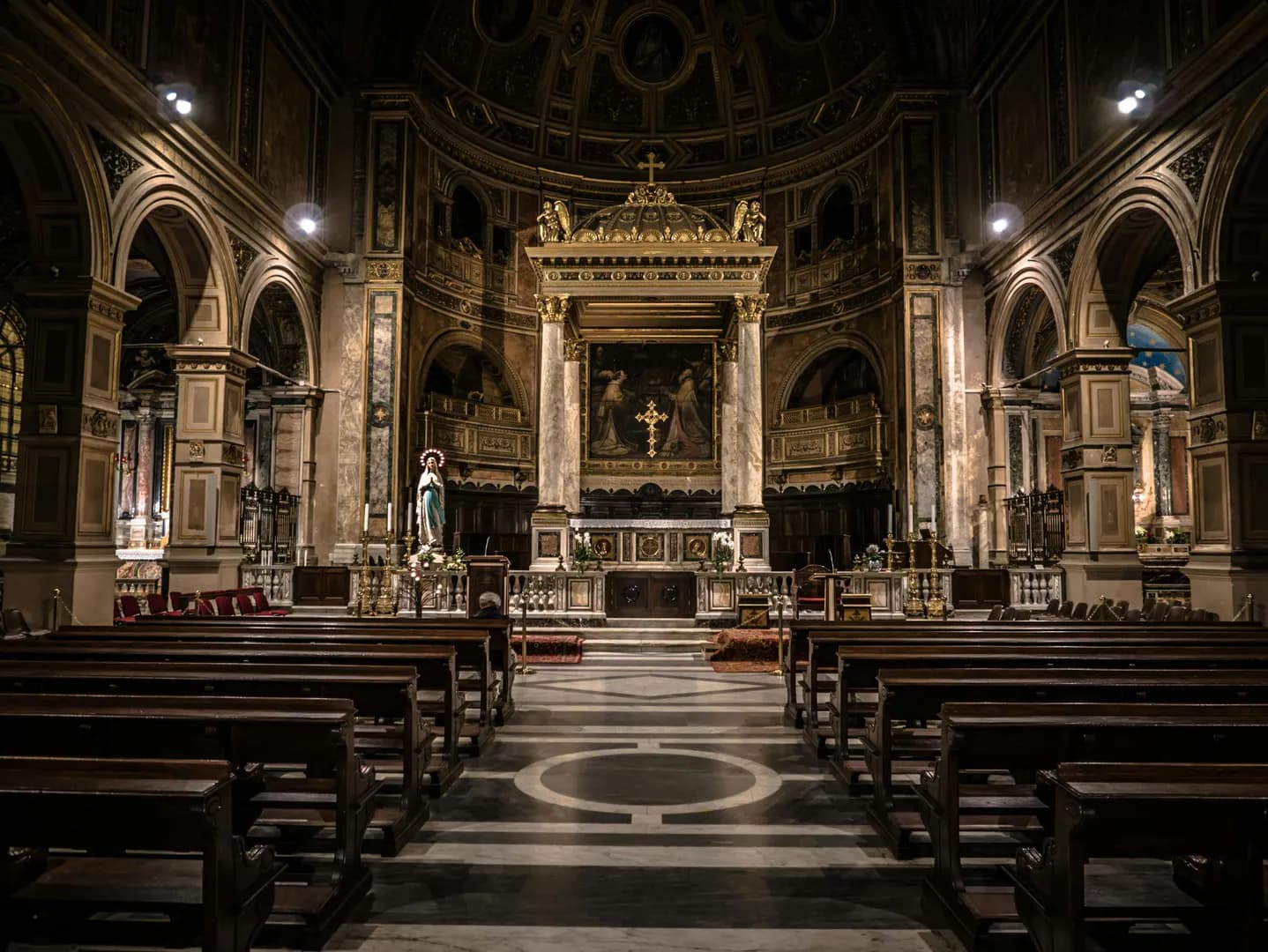
The Church of San Donato dominates the square with its Romanesque facade and mismatched bell tower. Inside, the single nave houses works of art accumulated over centuries: a wooden crucifix attributed to the School of Donatello, a fresco of the Madonna dating to the 15th century, and the relics of Saint Victoria, a Roman martyr whose bones have rested here since the 8th century.9
Beneath the church lie those Etruscan chambers, accessible during certain hours through the parish office. This vertical archaeology—Christian church above Etruscan tunnel—encapsulates Civita's layered history in a single structure.
The Village Streets
Beyond the piazza, Civita's streets invite wandering. The village measures only about 300 meters from end to end, small enough to explore thoroughly yet dense enough to reward repeated visits. Stone houses in various states of preservation line narrow lanes, their facades adorned with flowers in summer, their interiors glimpsed through open doorways.
Many houses have been purchased and restored by outsiders—Romans seeking weekend retreats, foreigners enchanted by Civita's atmosphere—creating an unusual community of part-time residents who arrive on weekends and holidays, inflating the population temporarily before withdrawing again to leave the permanent few in peaceful solitude.
Several small museums and artisan workshops occupy former residences. A geological museum explains the forces shaping and threatening the plateau. A traditional olive press demonstrates techniques unchanged since medieval times. Various artists maintain studios and galleries, their presence connecting contemporary creativity to Civita's long artistic heritage.
The Belvedere Views
At various points along Civita's perimeter, breaks in the buildings offer views into the surrounding valleys. These informal belvederes provide perspective both geographical and temporal—the vast emptiness surrounding this tiny inhabited speck, the Calanchi stretching toward distant hills, the precariousness that has defined existence here for centuries.
The western viewpoint looks toward Bagnoregio, the larger town from which Civita was violently separated. That connection, severed by earthquake, exists now only as a slender thread of footbridge—a visual reminder of how completely geology reshaped human geography in a single catastrophic night.
The Eternal Question: Preservation or Performance?
The Tourism Paradox
Civita's success presents uncomfortable questions. Has tourism saved the village or fundamentally altered it? Can a place maintain authenticity when its primary economic function is being visited? What does preservation mean when the thing being preserved is explicitly characterized by its disappearance?
Critics argue that Civita has become a theme park version of itself—a curated experience of decay rather than a genuine dying village. The carefully maintained facades, the restaurants serving refined cuisine, the gift shops selling local products all suggest a prosperity at odds with the "dying city" narrative that draws visitors.
Defenders counter that tourism represents the only viable economic model for a place without industry, agriculture, or significant permanent population. The money generated by visitors funds structural reinforcement, building restoration, and ongoing geological monitoring. Without tourism, Civita would likely complete its decline into uninhabited ruin within a generation.
Living Heritage
Perhaps the most thoughtful response comes from the residents themselves, whose continued presence amid the tourist flow represents a choice rather than mere inertia. These few inhabitants—running restaurants, maintaining gardens, sleeping in houses their families have occupied for generations—keep Civita from becoming pure museum.
Their lives proceed according to rhythms that predate and will outlast the tourist economy. They know their neighbors across centuries through family stories and parish records. They maintain traditions—particular recipes, specific farming techniques, characteristic ways of speaking—that connect living practice to historical continuity.
When the day-trippers depart and the restaurants close, these residents remain: tending their cats, watching the sunset from familiar benches, embodying the persistence that defines Civita as truly as its crumbling geology.
Practical Matters for Visitors
Getting to Civita di Bagnoregio
Civita lies approximately 120 kilometers north of Rome and 90 kilometers south of Siena, sitting right on the border between Tuscany and Umbria and making it accessible as a day trip from either city though deserving of longer consideration. The nearby town of Orvieto, with its spectacular cathedral and direct train service from Rome (one hour), serves as the most convenient base.
From Orvieto, Civita can be reached by car (30 minutes), taxi, or guided tour. Limited bus service connects Bagnoregio to Orvieto, from which visitors must walk approximately one kilometer to reach the footbridge.
Those driving should note that parking is available in Bagnoregio, not Civita itself, and it's worth reviewing what travelers renting a car in Italy need to know before setting out on the smaller roads of this region. The walk from parking area to footbridge takes about ten minutes, followed by the bridge crossing (another ten minutes for most visitors, longer for those with mobility limitations).
Entry Fees and Timing
Since 2013, visitors pay an entry fee to access Civita—currently €5 for adults, with reductions for students, seniors, and children.10 This revenue supports ongoing preservation efforts and infrastructure maintenance.
The village can be visited year-round, though hours vary seasonally. Summer sees extended access, while winter hours are more limited. Regardless of season, early morning and late afternoon visits offer the best light for photography and the thinnest crowds. The morning mist that so dramatically sets off Civita's silhouette typically burns off by mid-morning, returning again toward evening.
Where to Stay
For those wishing to experience Civita beyond day-trip status, several properties within the village offer accommodation. These range from simple rooms to elegantly restored houses, all sharing the unique quality of overnight access to a place that empties of visitors after sunset.
Staying in Civita means experiencing the village as its residents know it: quiet evenings with perhaps a dozen souls in the entire settlement, dawn light before the first day-trippers arrive, the particular silence of a place surrounded by emptiness. This experience, more than any daytime visit, reveals Civita's true character.
Bagnoregio and the surrounding countryside offer additional options, from agriturismi to small hotels. Orvieto provides the full range of tourist accommodation for those preferring urban amenities and transportation connections.
Combining with Other Destinations
Civita fits naturally into itineraries exploring central Italy's hilltop towns, and travelers who love its quiet corners often go on to seek out other overlooked pockets of Umbria. Orvieto's cathedral, with its stunning Gothic facade and Signorelli frescoes, lies just thirty minutes away. The gardens of Bomarzo, with their mysterious Renaissance monsters, require similar driving time in the opposite direction. Lake Bolsena, Viterbo, and the thermal springs of Saturnia all fall within easy reach.
For travelers deciding between a Tuscany or Umbria focus, or simply moving between Rome and Tuscany, Civita offers a memorable stop—though the village deserves more than the hurried hour that many tour itineraries allocate. Those who linger, returning perhaps for a second visit at different light, discover depths that quick visits cannot reveal.
Why Civita Matters
In an age of unprecedented connectivity, Civita di Bagnoregio stands as a monument to isolation. In a culture obsessed with permanence—with preservation, conservation, the defeat of entropy—it embraces transience. In a tourism industry often characterized by mass consumption, it offers an experience of genuine encounter with place and time.
The village will continue to crumble. Geologists estimate that significant portions of the plateau may fail within coming decades.11 Preservation efforts can slow but cannot stop the processes that have been reshaping this landscape since long before humans arrived. Eventually, perhaps within our grandchildren's lifetimes, Civita may exist only in photographs and memories.
This inevitable loss makes every visit precious. To walk Civita's streets is to participate in something irreplaceable—not merely seeing a beautiful place but witnessing the twilight of a civilization that began when Etruscans first carved their homes from living rock. The village asks nothing of visitors except attention, perhaps understanding, and the recognition that beauty and mortality are not opposites but companions.
In this recognition lies Civita's deepest gift: the reminder that impermanence enhances rather than diminishes value, that things ending deserve celebration rather than solely mourning, and that "dying" is merely another form of living—one that this remarkable village has practiced with grace for twenty-five centuries.
Frequently Asked Questions
How long does it take to visit Civita di Bagnoregio?
Most visitors spend between one and three hours in Civita—enough time to walk the village streets, visit the church, enjoy a meal or coffee, and take photographs. However, those seeking deeper immersion might consider staying overnight in one of the village's guest houses, experiencing Civita after the day-trippers depart.
Is Civita di Bagnoregio wheelchair accessible?
Unfortunately, accessibility is limited. The footbridge has a steep incline, and the village streets are paved with uneven stone. While not impossible for wheelchair users or those with mobility limitations, the visit presents significant challenges. Golf cart service is occasionally available from the bridge to the village gate.
Can you drive to Civita di Bagnoregio?
No. The village is accessible only by foot via the pedestrian bridge. Visitors must park in Bagnoregio and walk to the footbridge (approximately 10 minutes), then cross the bridge (another 10 minutes). This enforced pedestrian approach is fundamental to Civita's character.
Is Civita di Bagnoregio a UNESCO World Heritage Site?
Civita is on Italy's tentative list for UNESCO World Heritage status but has not yet received full designation.12 The unique combination of Etruscan heritage, medieval architecture, and geological drama makes a compelling case for recognition.
What is the best time of year to visit Civita?
Spring (April-May) and autumn (September-October) offer ideal conditions: pleasant temperatures, manageable crowds, and beautiful light. Summer brings heat and peak tourist numbers but extended hours. Winter visits reward with dramatic atmosphere and solitude but require flexibility regarding reduced opening hours.
Is there food available in Civita di Bagnoregio?
Yes, several restaurants and cafes operate within the village, ranging from casual trattorias to more refined establishments. Local specialties include dishes featuring wild boar, porcini mushrooms, and the excellent olive oil produced in the surrounding region. Given the village's small size, reservations are advisable for dinner, especially on weekends.
References
- Nappi, G., et al. "The Vulsini Volcanic District: Geological and Volcanological Framework." Geological Society of Italy, 1998.
- Municipality of Bagnoregio. "Civita di Bagnoregio: Demographic Statistics 2020-2024." Official Records, 2024.
- Timperi, A. "Civita di Bagnoregio: Etruscan Heritage and Archaeological Evidence." Soprintendenza Archeologia del Lazio, 2015.
- Diocese of Viterbo. "Historical Documentation: The Cathedral of San Donato, Civita." Ecclesiastical Archives, 2010.
- Boschi, E. "Earthquakes of the Viterbo Region: Historical Seismology 1600-1900." INGV Publications, 2000.
- Zevi, Bruno. "Civita di Bagnoregio: Architecture as Memory." Einaudi, 1978.
- Italian Ministry of Tourism. "Visitor Statistics: Minor Historical Centers 2023." ENIT Report, 2024.
- Municipality of Bagnoregio. "The Footbridge to Civita: Engineering and History." Technical Documentation, 2019.
- Parish of San Donato. "The Church and Its Treasures: An Official Guide." Civita di Bagnoregio, 2020.
- Municipality of Bagnoregio. "Access Regulations and Tariffs for Civita di Bagnoregio." Official Ordinance, 2024.
- Delmonaco, G. "Slope Instability at Civita di Bagnoregio: Geological Assessment and Monitoring." ISPRA Technical Report, 2021.
- UNESCO World Heritage Centre. "Italy Tentative List: Civita di Bagnoregio and the Valle dei Calanchi." Documentation, 2018.